Past perfect continuous tense
Learn how to form and use the past perfect continuous tense (had been + verb-ing) with clear rules, examples, common mistakes and practice quizzes.
In this lesson
The past perfect continuous tense, also called the past perfect progressive, describes an action that started before a point in the past and continued up to that point. We form it with had been and the -ing form of the verb. For example: She had been studying for two hours when I arrived.
Key point
Use had been + verb-ing to show that an action was in progress for some time before another past action or time. The form is the same for every subject: I had been, she had been, they had been.
When do you use the past perfect continuous?
We use this tense when we stand at a moment in the past and look back at an earlier action that was going on for a while. There are two main uses.
1. An action that continued up to a past moment
We often say how long the action lasted, so this tense goes well with for, since and all day.
Examples
- I had been waiting for 40 minutes when the bus finally came.
- They had been living in Kandy since 2015 when they decided to move to Colombo.
- By midnight, we had been talking for five hours.
2. The cause of a past situation
We also use it to explain why something was true at a past time. The result is often something you could see, such as tired eyes, wet roads or dirty hands.
Examples
- She was tired because she had been running.
- The roads were wet. It had been raining all morning.
- His hands were dirty because he had been fixing his bicycle.
How do you form the past perfect continuous?
The structure is subject + had + been + verb-ing. It does not change for he, she or it, so there is no extra -s to remember.
| Form | Structure | Example |
|---|---|---|
| Positive | Subject + had + been + verb-ing | I had been studying. |
| Negative | Subject + had not (hadn’t) + been + verb-ing | She hadn’t been studying. |
| Question | Had + subject + been + verb-ing? | Had you been studying? |
| Short answers | Yes, subject + had. / No, subject + hadn’t. | Yes, I had. / No, I hadn’t. |
Note
In speech, had often becomes ‘d: I’d been working, they’d been waiting. The short form ‘d can also mean would, so use the rest of the sentence to decide. See our lesson on contracted forms in English for more.
Positive sentences
Put had been after the subject, then add the main verb with -ing.
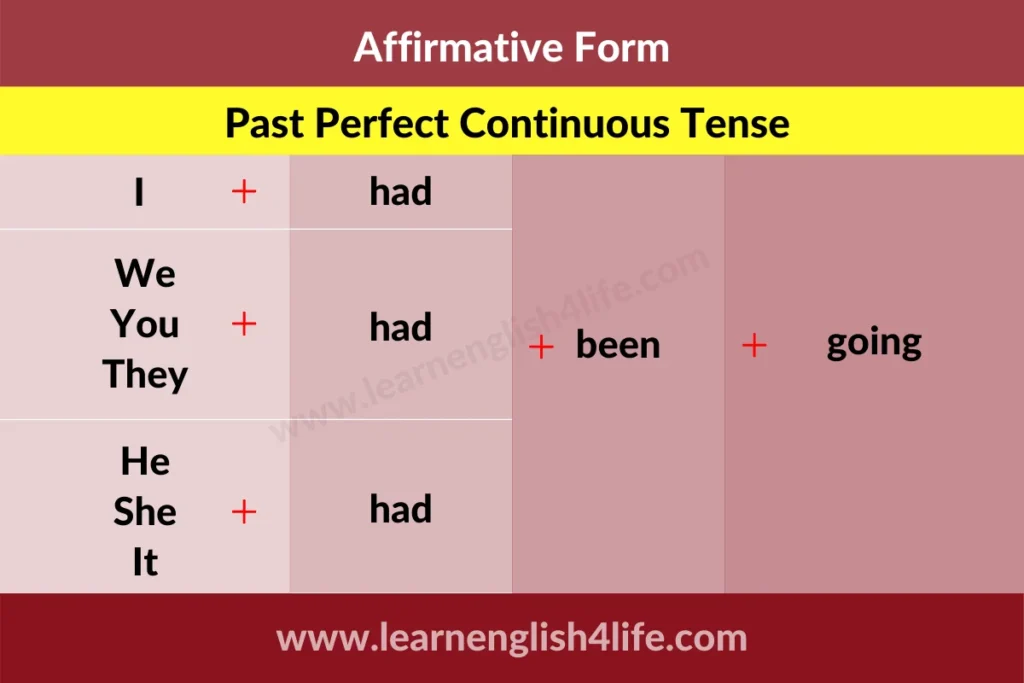
Examples
- I had been studying.
- I had been writing a letter.
- You had been drawing a sketch of a map.
- We had been practising a dance.
- We had been cleaning the house.
- They had been running in the morning.
- She had been dancing well all evening.
- Kate and I had been playing games.
- The director had been blaming them.
- It had been eating.
How do you make the negative?
Add not after had. In speaking and informal writing, we usually use the short form hadn’t.
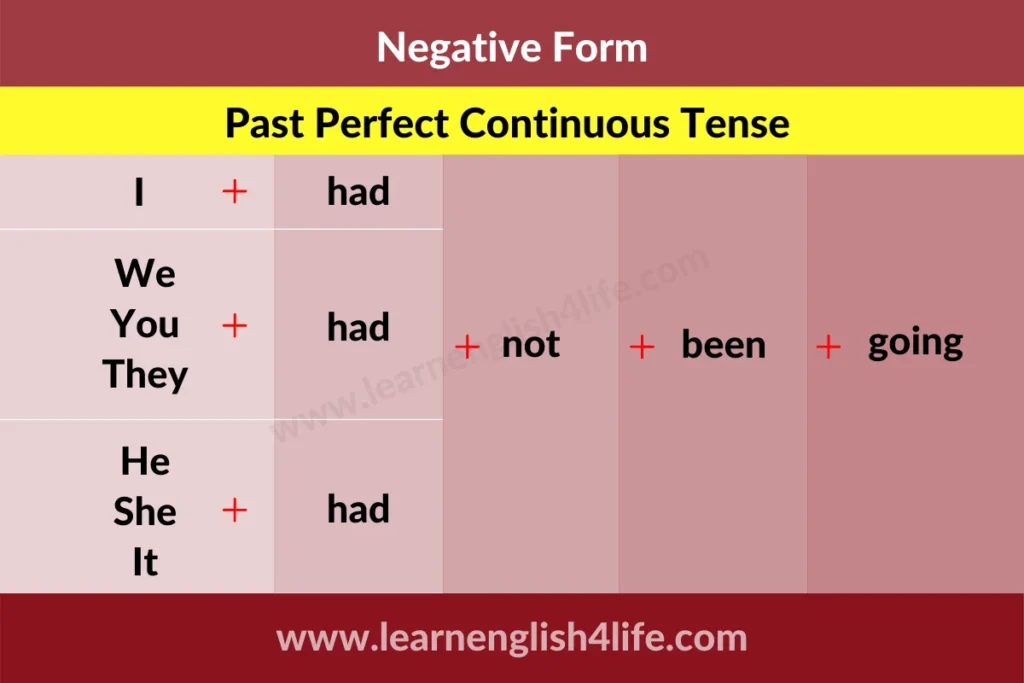
Examples
- I had not been writing the letter. / I hadn’t been writing the letter.
- You had not been playing cricket. / You hadn’t been playing cricket.
- We had not been completing the task. / We hadn’t been completing the task.
- She had not been studying. / She hadn’t been studying.
- The teacher had not been explaining the lesson. / The teacher hadn’t been explaining the lesson.
Common mistake
She hadn’t been study. → She hadn’t been studying. The main verb always takes -ing, in negatives too.
How do you ask questions?
Move had to the front, before the subject. Keep been and the -ing verb after the subject. For a question with a question word, put the word first: How long had you been waiting? Our lesson on wh- questions and question words explains this pattern.
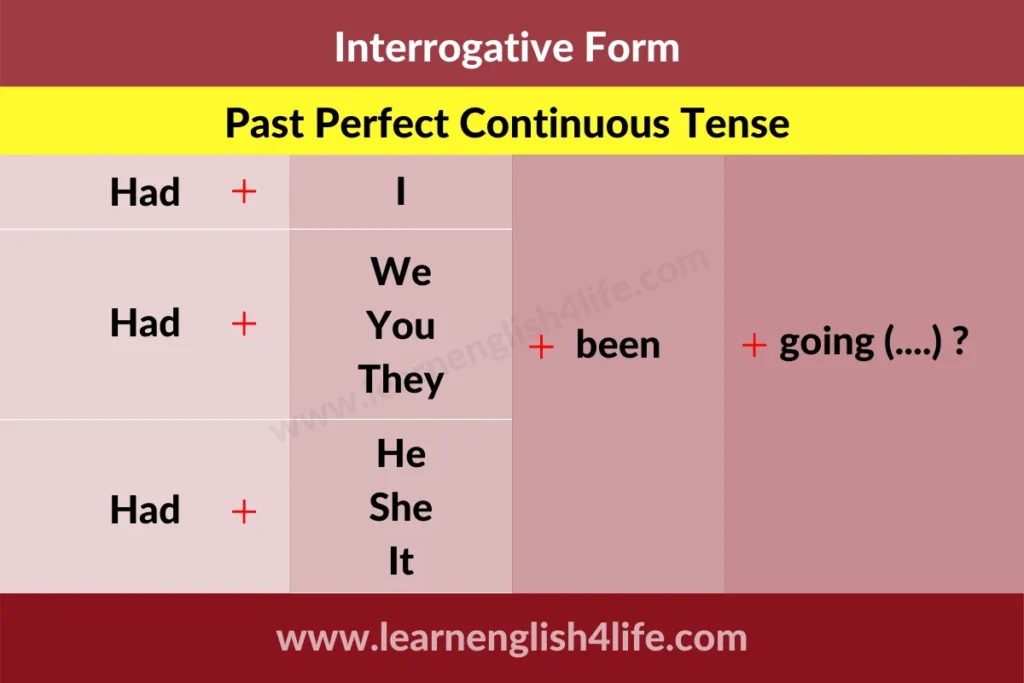
Examples
- Had I been going?
- Had I been studying?
- Had you been singing?
- Had you been reading?
- Had we been starting?
- Had we been planning?
- Had she been cooking?
- Had he been working?
- Had Eliza been sleeping?
- Had the dog been barking?
Tip
The most common question in this tense starts with How long. Answer it with for (a length of time) or since (a starting point): “How long had you been waiting?” “I had been waiting for an hour.”
Past perfect continuous or past perfect simple?
Both tenses look back from a moment in the past. The continuous form puts the focus on the activity and how long it lasted. The simple form puts the focus on the finished result.
Examples
- She had been painting the room. (We think about the activity. There was paint on her clothes.)
- She had painted the room. (The job was finished. The room was a new colour.)
You can study the simple form in our lesson on the past perfect tense.
Common mistake
I had been knowing him for years. → I had known him for years. Stative verbs such as know, like, believe, own and understand describe states, not actions, so we usually use the past perfect simple with them.
How is it different from other continuous tenses?
The present perfect continuous tense (have or has been + verb-ing) connects an activity to now: I have been waiting for an hour (I am still waiting). The past perfect continuous connects it to a past moment: I had been waiting for an hour when she arrived.
The past continuous tense (was or were + verb-ing) shows an action in progress at one past moment, without looking back to an earlier time: I was waiting when she arrived.
For more practice and examples, read the Cambridge Dictionary grammar guide to the past perfect continuous and the British Council LearnEnglish reference page on the past perfect.
Summary
- Form: subject + had + been + verb-ing. It is the same for every subject.
- Use it for an action that continued up to a moment in the past, often with for or since.
- Use it to explain the cause of a past situation: She was tired because she had been running.
- Negative: hadn’t been + verb-ing. Question: Had + subject + been + verb-ing?
- Do not use it with stative verbs such as know, like or believe.
Frequently asked questions
What is the formula of the past perfect continuous tense?
The formula is subject + had + been + verb-ing, for example: They had been playing football. It does not change for he, she or it.
What is the difference between the past perfect and the past perfect continuous?
The past perfect (had + past participle) focuses on a finished action or its result. The past perfect continuous (had been + verb-ing) focuses on the activity and how long it continued before another past moment.
Is the past perfect continuous the same as the past perfect progressive?
Yes. Continuous and progressive are two names for the same tense. British course books usually say continuous, and American books often say progressive.
Does the past perfect continuous always need another past action?
It needs a past reference point, but this can be a time or something already clear from the conversation. For example: By midnight, we had been talking for five hours.
Which time words go with the past perfect continuous?
Common ones are for, since, all day, all morning, how long, before and when. For example: How long had you been living there before you moved?
Practise this lesson
5 questions
5 questions
5 questions