Simple future tense
Learn how to use the simple future tense with will and shall: positive, negative and question forms, examples, common mistakes and practice quizzes.
In this lesson
The simple future tense talks about actions and events that have not happened yet. We usually form it with will and the base form of the verb, for example I will call you tomorrow. We use it for predictions, promises, offers and decisions that we make at the moment of speaking.
Key point
Use will + base verb (no -s, no -ing, no to) with every subject: I will go, she will go, they will go. Shall is a more formal choice, and we use it only with I and we.
When do you use the simple future tense?
The simple future tense has several common uses. Here are the most important ones, with an example for each.
Examples
- A prediction: I think you will pass the exam.
- A decision made now: The phone is ringing. I’ll answer it.
- A promise: I will help you with your homework.
- An offer: I’ll carry that bag for you.
- A request: Will you open the window, please?
Will or shall?
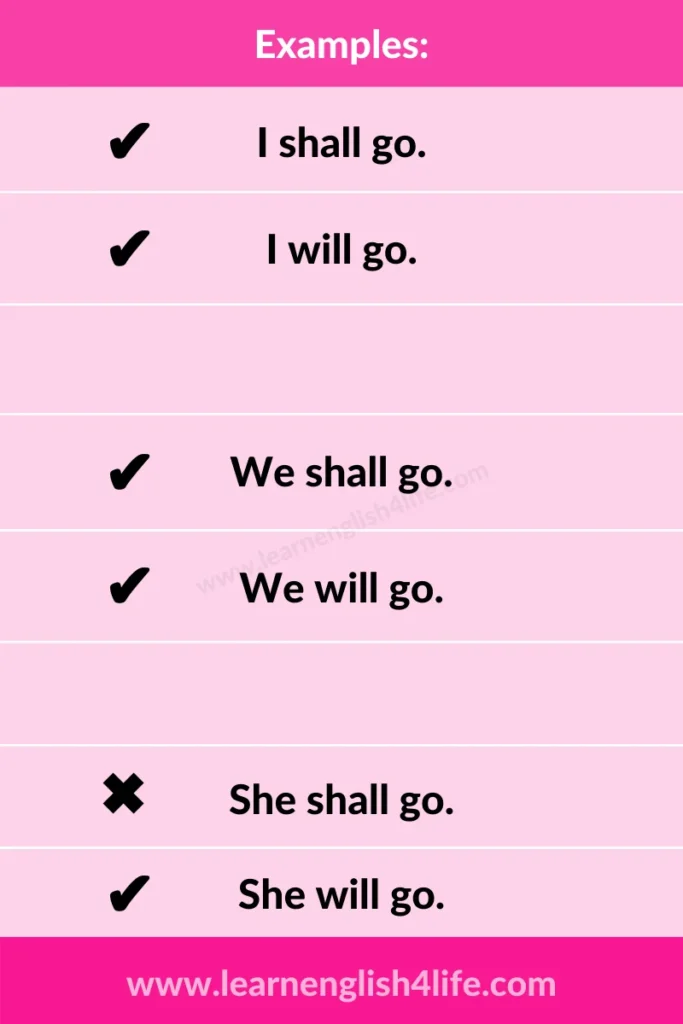
We use will with all subjects. Shall is used only with I and we. In modern English, shall appears mostly in questions that make an offer or a suggestion, such as Shall I help you? or Shall we go? In statements, I shall and we shall sound formal, so many speakers say I will and we will instead.
Note
Shall is more common in British English than in American English. American speakers rarely use it in everyday conversation, except in questions like Shall we?
How do you form the simple future tense?
The verb after will is always the base form. It never changes, whatever the subject is.
| Form | Structure | Example |
|---|---|---|
| Positive | Subject + will + base verb | She will write. |
| Negative | Subject + will not (won’t) + base verb | She won’t write. |
| Question | Will + subject + base verb? | Will she write? |
| Short answers | Yes, subject + will. / No, subject + won’t. | Yes, she will. / No, she won’t. |
Common mistake
She will goes to school tomorrow. → She will go to school tomorrow. After will, use the base form. Do not add -s, even with he, she or it.
Positive sentences
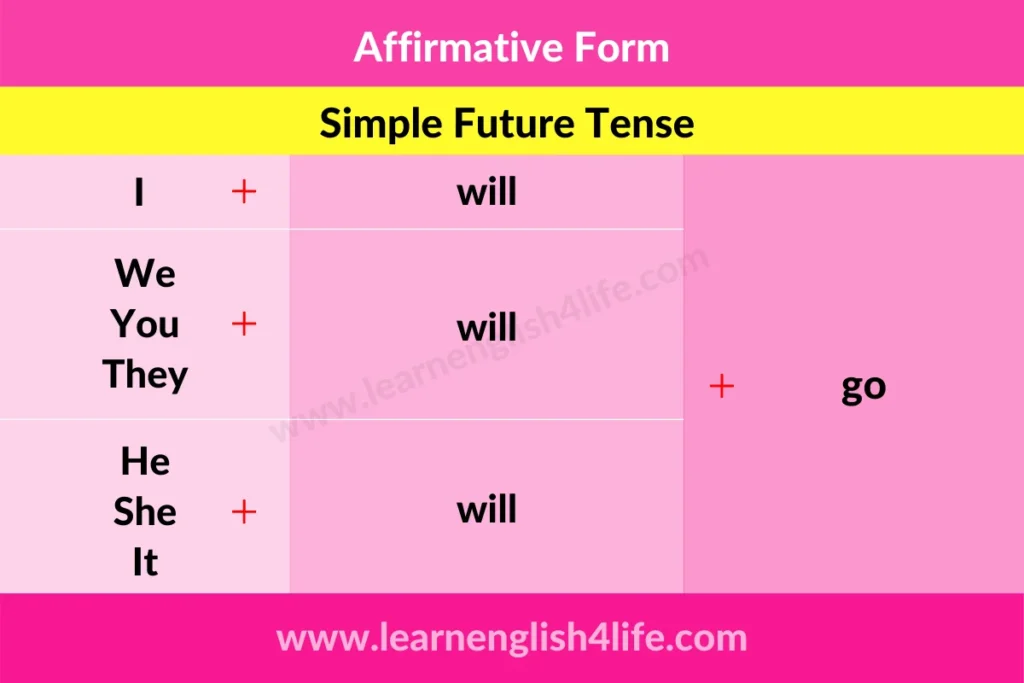
The affirmative (positive) form follows this structure: subject + will + base verb. In speech, will usually becomes ‘ll: I’ll, you’ll, he’ll, she’ll, we’ll, they’ll.
Examples
- I shall pass my exam. / I will pass my exam.
- We shall enjoy it. / We will enjoy it.
- You will go. / You’ll go.
- They will play. / They’ll play.
- He will run. / He’ll run.
- She will write. / She’ll write.
She’ll is the contracted form of she will. You can learn all the short forms in our lesson on contracted forms in English.
How do you make the negative?
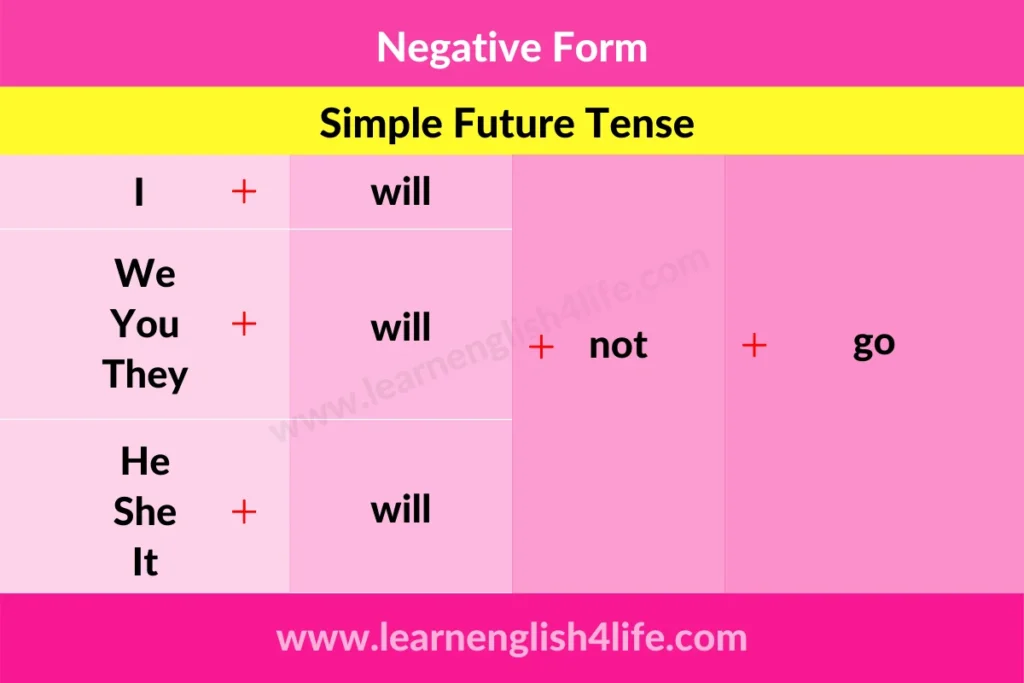
Put not after will. The short form of will not is won’t.
Examples
- I will not go. / I won’t go.
- You will not play. / You won’t play.
- We will not start. / We won’t start.
- They will not practise. / They won’t practise.
- She will not write. / She won’t write.
Note
The negative of shall is shall not, and its short form is shan’t. Shan’t is rare today and sounds old-fashioned, so most people say won’t.
How do you ask questions?
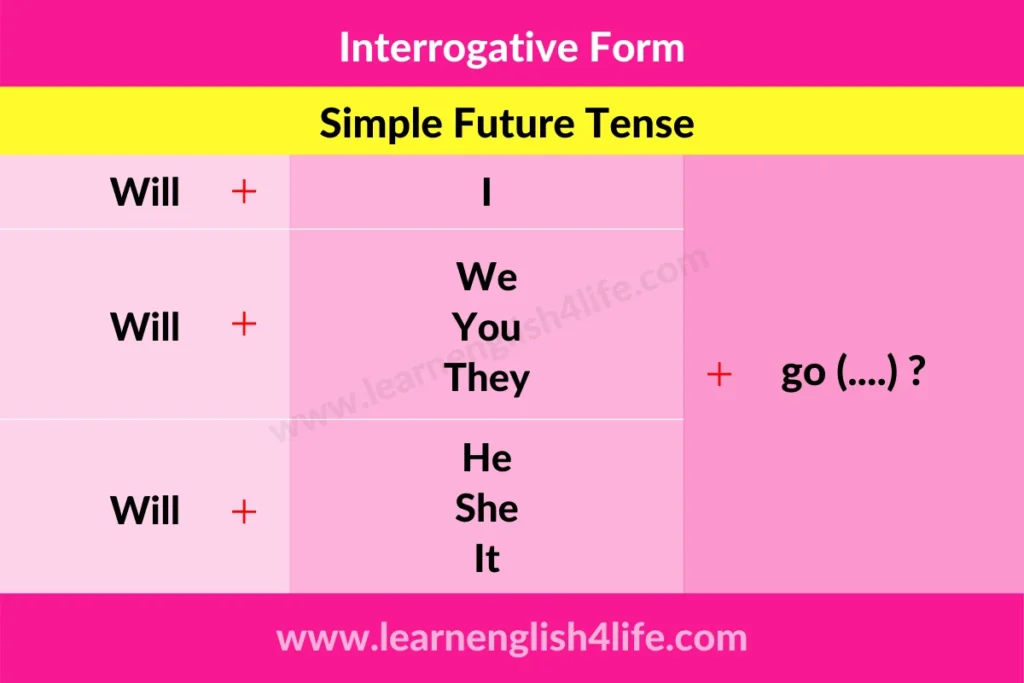
Put will at the beginning, before the subject, and keep the rest of the sentence in the same order. For offers and suggestions with I or we, use shall. To ask for information, put a question word before will: When will you arrive? Where will they stay? Our lesson on wh- questions and question words shows how these work.
Examples
- Shall we go?
- Shall I go?
- Will you marry him?
- Will you go there?
- Will you explain?
- Will they start?
- Will she dance?
- Will she cook?
- Will he make dinner?
- Will my mother blame me?
Tip
Answer a will question with a short answer: Yes, I will. or No, I won’t. Do not use the short form ‘ll at the end of a positive answer. Say Yes, I will, not Yes, I’ll.
Will or going to?
Both forms talk about the future, but they are not always the same. We often use be going to for plans we made before speaking and for predictions based on something we can see now. We use will for decisions we make at the moment of speaking.
Examples
- I’m going to visit my aunt on Sunday. (a plan made earlier)
- Look at those dark clouds. It’s going to rain. (we can see the evidence now)
- “We have no milk.” “Oh, I’ll buy some.” (a decision made now)
For a deeper comparison, read the British Council LearnEnglish lesson on will, be going to and the present continuous.
Do you use will after when and if?
No. After time words such as when, before, after and as soon as, and after if, we use the present simple, even when we mean the future. Will goes in the other part of the sentence.
Common mistake
When I will arrive, I will call you. → When I arrive, I will call you.
This pattern is the first conditional. You can study it in our lesson on conditional sentences, and revise the present simple in our simple present tense lesson. When you are ready for the next step, try the future continuous tense. The Cambridge Dictionary grammar guide to will and shall has more examples.
Summary
- Form: subject + will + base verb, the same for every subject.
- Use it for predictions, promises, offers, requests and decisions made now.
- Negative: will not or won’t. Question: Will + subject + base verb?
- Shall is used only with I and we, mostly in offers and suggestions.
- After when, if and as soon as, use the present simple, not will.
Frequently asked questions
What is the formula of the simple future tense?
The formula is subject + will + base verb, for example: They will play football. The verb after will never changes.
Can I use shall with you, he or she?
Not in modern everyday English. Shall is used with I and we, mostly in offers and suggestions such as Shall I help you?
What is the short form of will not?
The short form is won’t, for example: I won’t be late. It is common in speech and informal writing.
Is it correct to use I’ll in formal writing?
Short forms like I’ll and won’t are normal in speech, messages and friendly emails. In formal essays and letters, the full forms will and will not are usually better.
Is will the only way to talk about the future?
No. English also uses be going to for plans, the present continuous for arrangements (I’m meeting her at six) and the present simple for timetables (The train leaves at eight).
Practise this lesson
5 questions
5 questions
5 questions