Future continuous tense
Learn how to form and use the future continuous tense (will be + verb-ing) with clear rules, examples, common mistakes and practice quizzes.
In this lesson
The future continuous tense describes an action that will be in progress at a particular time in the future. We form it with will be and the -ing form of the verb, for example: This time tomorrow, I will be travelling to Kandy. It is also a polite way to ask about someone’s plans.
Key point
Use will + be + verb-ing for an action that will be happening at a certain moment in the future. The form is the same for every subject, and we usually use it only with action verbs.
When do you use the future continuous?
1. An action in progress at a future time
Imagine a moment in the future. The future continuous describes what will be happening at that moment. The action starts before that time and continues after it.
Examples
- At eight o’clock tonight, I will be watching the match.
- She will be writing the exam tomorrow at this time.
- Please don’t call at one. We will be having lunch.
2. A longer action that another event interrupts
We often use the future continuous with a short action in the present simple after when.
Examples
- When you arrive, I will be waiting at the station.
- When the film starts, they will be sitting in their seats.
3. Polite questions about plans
A future continuous question asks about someone’s plans without pushing them. It sounds softer than a direct request.
Examples
- Will you be using the car this evening?
- Will you be joining us for dinner?
How do you form the future continuous?
The structure is subject + will + be + verb-ing. It does not change for he, she or it.
| Form | Structure | Example |
|---|---|---|
| Positive | Subject + will + be + verb-ing | They will be studying. |
| Negative | Subject + will not (won’t) + be + verb-ing | They won’t be studying. |
| Question | Will + subject + be + verb-ing? | Will they be studying? |
| Short answers | Yes, subject + will. / No, subject + won’t. | Yes, they will. / No, they won’t. |
The future continuous is used with action verbs, such as go, run, do and read. We do not usually use it with stative verbs, which describe states, such as know, believe, love and own.
Common mistake
This time next week, I will be knowing the results. → This time next week, I will know the results. Know is a stative verb, so use the simple future instead.
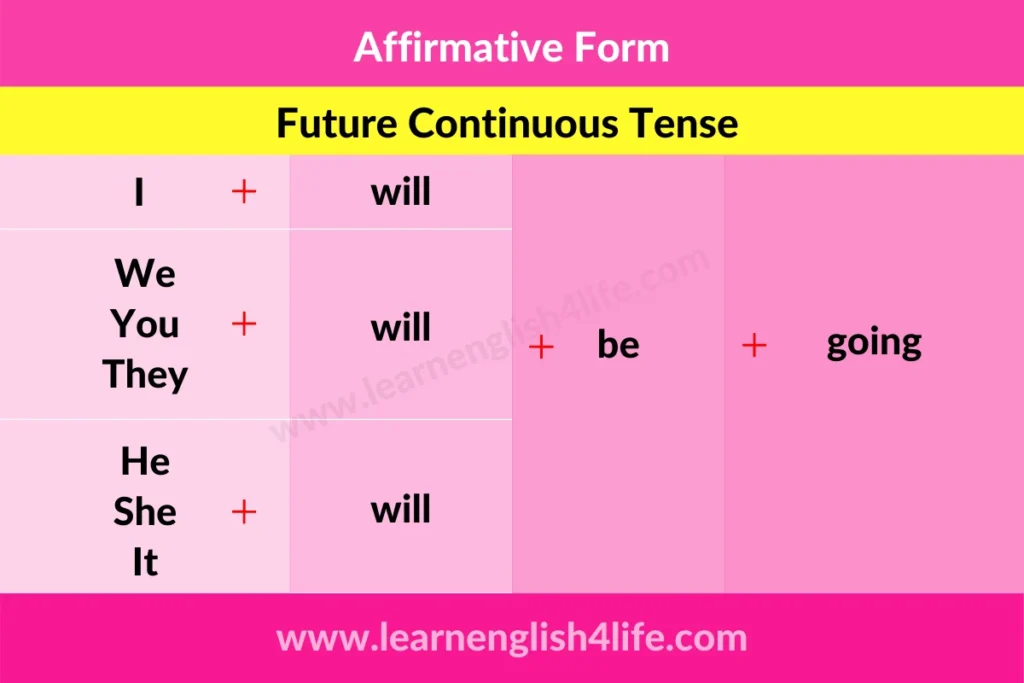
Positive sentences
Put will be after the subject, then add the main verb with -ing. In speech, will usually becomes ‘ll.
Examples
- I will be meeting him at 3.00 pm. / I’ll be meeting him at 3.00 pm.
- You will be going. / You’ll be going.
- We will be playing cricket. / We’ll be playing cricket.
- They will be studying. / They’ll be studying.
- She will be writing the exam tomorrow at this time. / She’ll be writing the exam tomorrow at this time.
How do you make the negative?
The negative form follows this structure: subject + will + not + be + verb-ing. The short form of will not is won’t.
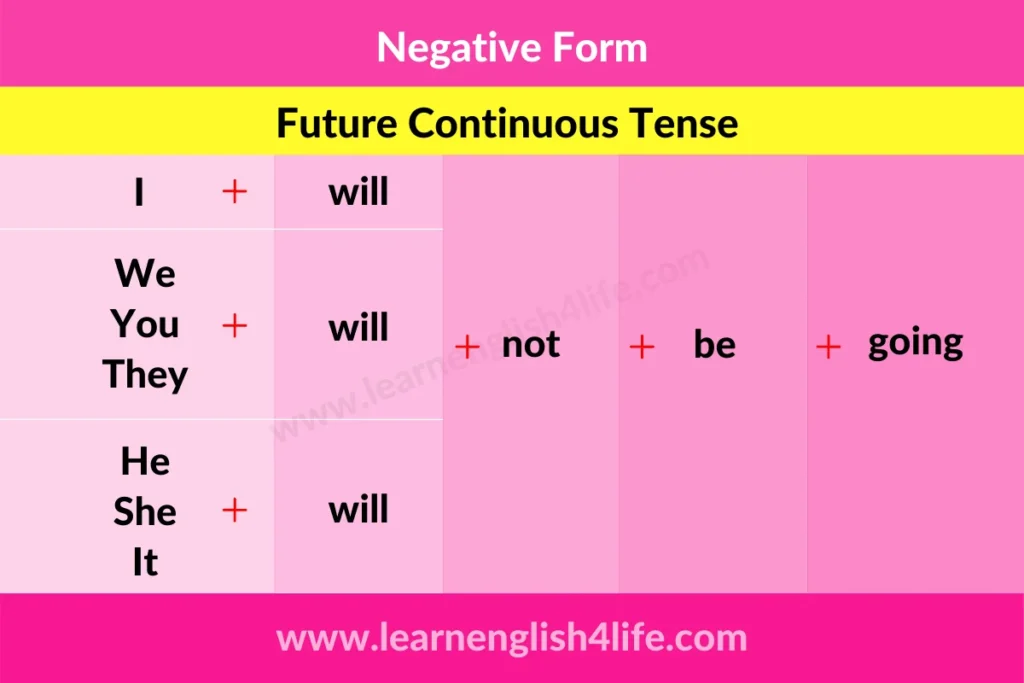
Examples
- I will not be doing it. / I won’t be doing it.
- We will not be working. / We won’t be working.
- They will not be dancing in the competition. / They won’t be dancing in the competition.
- They will not be visiting their friends. / They won’t be visiting their friends.
- Ellie will not be singing in the concert tomorrow. / Ellie won’t be singing in the concert tomorrow.
Common mistake
I will not doing it. → I will not be doing it. Do not forget be between will (not) and the -ing verb.
How do you ask questions?
Put will before the subject, then add be and the -ing verb. To ask for information, start with a question word: What will you be doing at ten o’clock? See our lesson on wh- questions and question words for more examples.
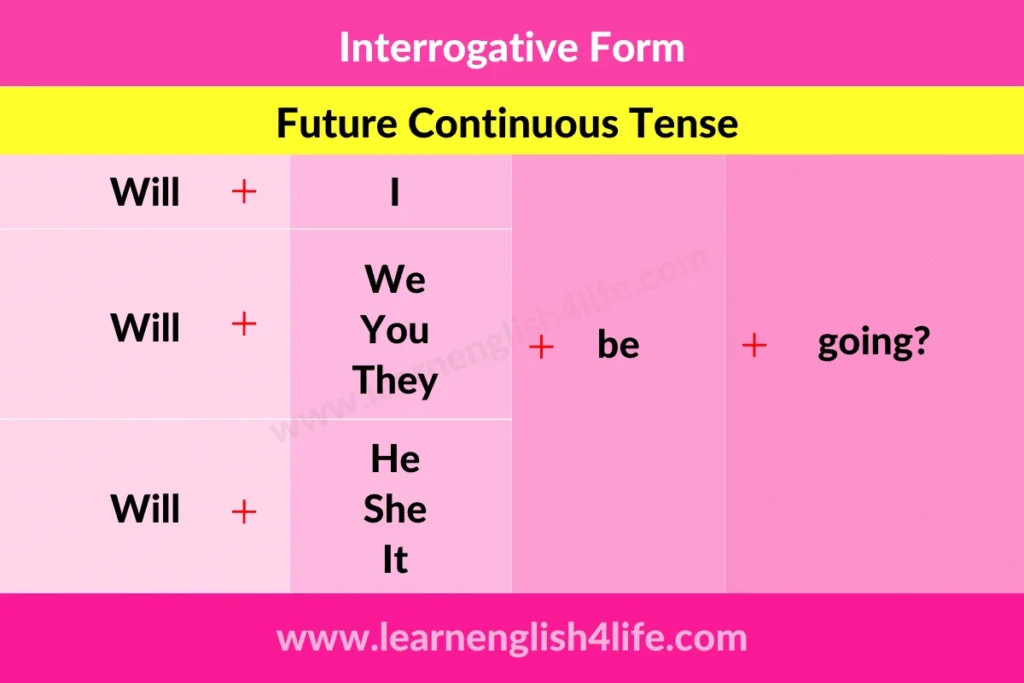
Examples
- Will you be watching TV?
- Will they be playing cricket?
- Will she be dancing in the competition?
- Will he be studying for the exam?
- Will the teacher be teaching English?
Tip
“Will you use the printer?” can sound like an order. “Will you be using the printer later?” simply asks about the person’s plans, so it is more polite when you want something.
Future continuous or simple future?
The simple future tense shows a complete action at a future time. The future continuous shows an action that is already in progress at that time.
Examples
- I will cook dinner at six. (I will start cooking at six.)
- I will be cooking dinner at six. (I will be in the middle of cooking at six.)
The idea is the same as the past continuous tense, but in the future: I was cooking at six yesterday becomes I will be cooking at six tomorrow. When you know this tense well, move on to the future perfect tense, which looks back from a point in the future.
For extra practice, read the Cambridge Dictionary grammar guide to the future continuous and the British Council LearnEnglish lesson on the future continuous and future perfect.
Summary
- Form: subject + will + be + verb-ing, the same for every subject.
- Use it for an action that will be in progress at a certain future time.
- Negative: won’t be + verb-ing. Question: Will + subject + be + verb-ing?
- Will you be …ing? is a polite way to ask about plans.
- Do not use it with stative verbs such as know, believe or own.
Frequently asked questions
What is the formula of the future continuous tense?
The formula is subject + will + be + verb-ing, for example: We will be playing cricket. Will and be never change, whatever the subject is.
What is the difference between I will do and I will be doing?
I will do talks about a complete action in the future. I will be doing describes an action that will be in progress at a certain moment, for example: At nine, I will be doing my homework.
Which time expressions go with the future continuous?
Common ones are this time tomorrow, this time next week, at eight o’clock tonight, all day tomorrow and when you arrive. They help the listener picture a moment in the future.
Can I use going to instead of will in this tense?
Yes. Be going to be + verb-ing has a similar meaning, for example: I’m going to be working late tonight. Will be + verb-ing is more common.
Practise this lesson
5 questions
5 questions