The verb ‘be’
Learn how to use am, is and are, the present forms of the verb 'be', in positive sentences, negatives and questions, with examples and practice.
In this lesson
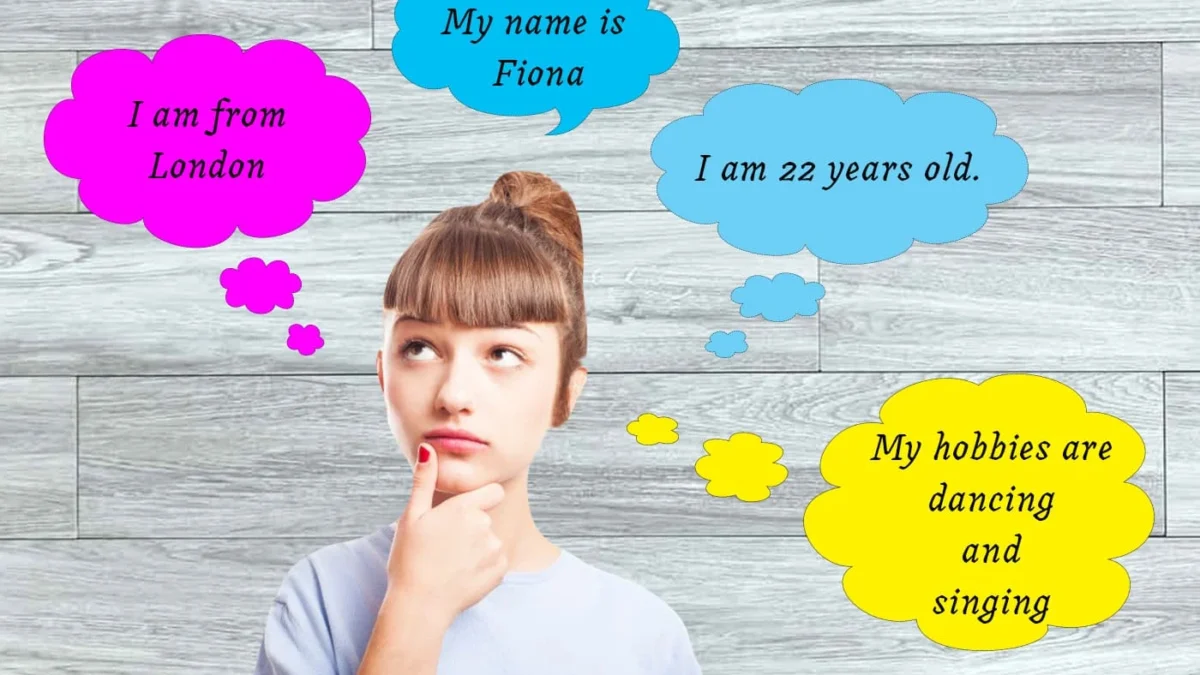
The verb be is one of the most common verbs in English. In the present simple it has three forms: am, is and are. We use it to say who or what something is, and to describe age, feelings, places and qualities, for example I am a student and She is 23 years old.
Key point
Use am with I, is with he, she, it and singular nouns, and are with you, we, they and plural nouns. Add not to make a negative, and put the verb before the subject to make a question.
What are the forms of the verb ‘be’?
‘Be’ is an irregular verb, so its forms change a lot. It can be a main verb (She is happy.) or an auxiliary verb, which is a helping verb that works with another verb (She is reading.). We use it to talk about permanent or temporary qualities and states.
| Form | Words | Example |
|---|---|---|
| Base form | be | I want to be a doctor. |
| Present simple | am, is, are | We are friends. |
| Past simple | was, were | I was tired yesterday. |
| -ing form | being | You are being very kind today. |
| Past participle | been | She has been ill this week. |
This lesson focuses on the present simple forms am, is and are. You can learn was and were in our simple past tense lesson. For more detail on every form, see the British Council grammar reference on the verb ‘be’.
Which form do you use: am, is or are?
The form depends on the subject of the sentence.
| Subject | Verb | Example |
|---|---|---|
| I | am | I am a pilot. |
| He, she, it | is | It is a sunny day. |
| One person or thing (Kate, my bed) | is | My bed is comfortable. |
| You, we, they | are | We are friends. |
| Two or more people or things (her friends) | are | Her friends are very helpful. |
Tip
Only I takes am. One person or thing (not you and not me) takes is. Two or more take are. You always takes are, even when you talk to one person.
Positive, negative and question forms at a glance
| Subject | Positive | Negative | Question |
|---|---|---|---|
| I | I am (I’m) | I am not (I’m not) | Am I? |
| He, she, it | She is (she’s) | She is not (she isn’t) | Is she? |
| You, we, they | They are (they’re) | They are not (they aren’t) | Are they? |
How do you make positive sentences with ‘be’?
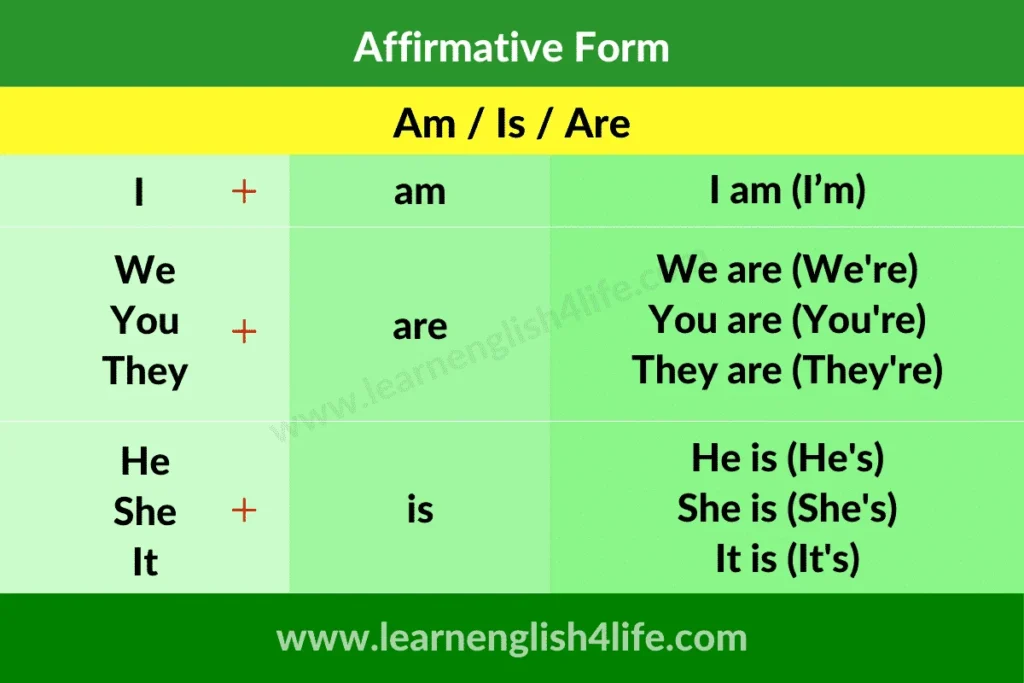
The positive (affirmative) form is: subject + am, is or are + the rest of the sentence. In speaking and informal writing we often use short forms: I’m, he’s, she’s, it’s, you’re, we’re and they’re.
Examples
- She is 23 years old. / She’s 23 years old.
- We are friends. / We’re friends.
- It is a sunny day. / It’s a sunny day.
- Her friends are very helpful.
- My bed is comfortable.
Note
She’s and we’re are contracted forms. The apostrophe (‘) shows where a letter is missing. Study them in our lesson on contracted forms in English.
How do you make the negative?
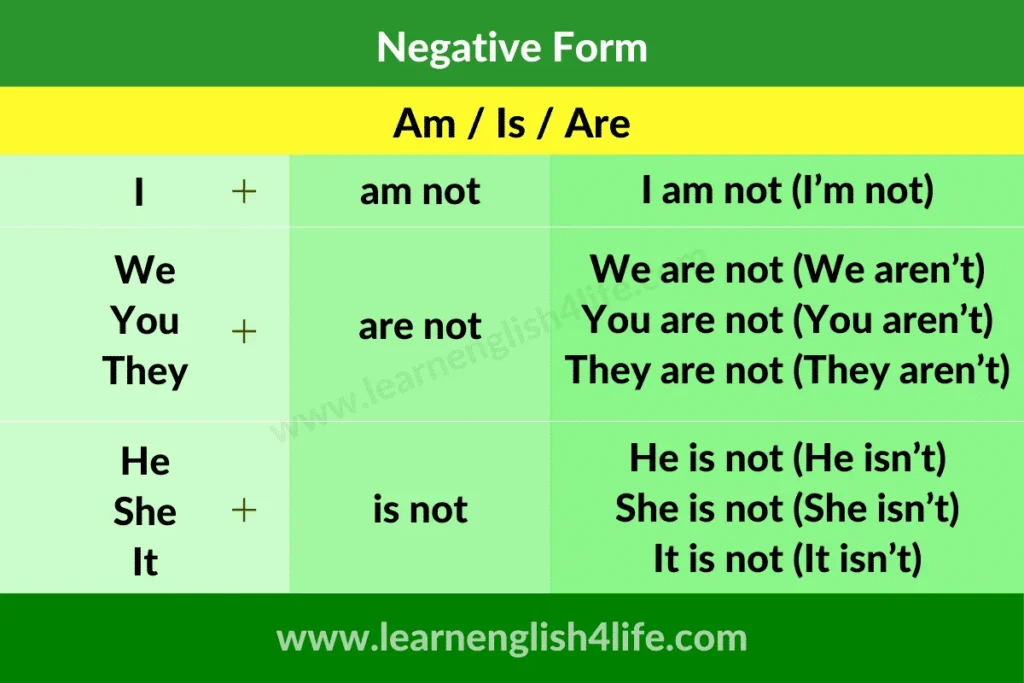
To make a negative sentence, put not after am, is or are. The short forms are isn’t and aren’t. For I am not, the short form is I’m not.
Examples
- I am not well today. / I’m not well today.
- She is not angry. / She isn’t angry.
- They are not enemies. / They aren’t enemies.
- Today is not Monday. / Today isn’t Monday.
- Kate is not at home today. / Kate isn’t at home today.
Note
There are two correct short forms for is not and are not: She isn’t angry or She’s not angry, and They aren’t enemies or They’re not enemies.
Common mistake
I amn’t late. → I’m not late.
How do you ask questions with ‘be’?
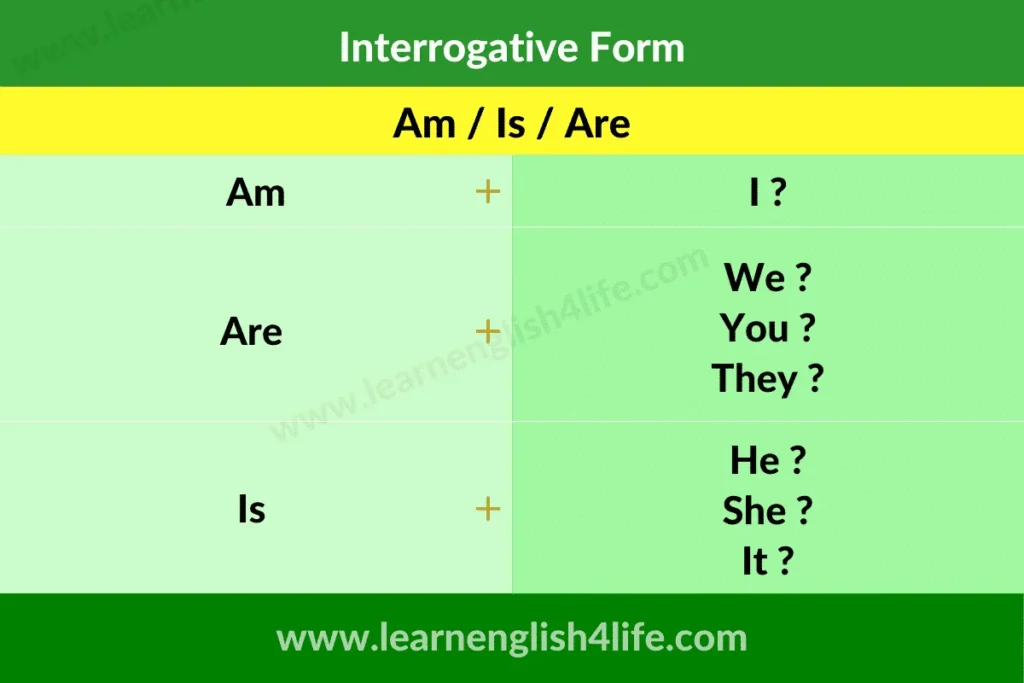
To make a yes/no question, put am, is or are before the subject. She is hungry. becomes Is she hungry?
Examples
- Am I late today?
- Are you hungry?
- Is he angry with you?
- Are you married?
- Is Kate helpful?
Short answers
We usually answer yes/no questions with a short answer: Yes or No + subject + am, is or are.
Examples
- Are you hungry? Yes, I am. / No, I’m not.
- Is Kate helpful? Yes, she is. / No, she isn’t.
- Are they from Australia? Yes, they are. / No, they aren’t.
Common mistake
Are you married? Yes, I’m. → Are you married? Yes, I am.
Questions with question words
Put the question word first, then am, is or are, then the subject: Where is Kate?, How old are you?, What is your name? Learn more in our lesson on Wh- questions and question words. For extra exercises, try the British Council LearnEnglish lesson on the present simple of ‘to be’.
How is ‘be’ used as a helping verb?
‘Be’ also helps other verbs. With an -ing verb it forms the present continuous tense: I am reading. They are playing cricket. With a past participle it forms the passive: English is spoken in many countries. The rules for am, is and are stay the same. Other verbs work differently in the present: they use do and does in negatives and questions, as you will see in the simple present tense lesson.
Summary
- Use am with I, is with he, she, it and singular nouns, and are with you, we, they and plural nouns.
- Negative: add not (I’m not, she isn’t, they aren’t).
- Question: put am, is or are before the subject (Is she ready?).
- Short answers: Yes, I am. / No, she isn’t.
- ‘Be’ is irregular: be, am, is, are, was, were, being, been.
Frequently asked questions
When do I use am, is and are?
Use am only with I. Use is with he, she, it and one person or thing. Use are with you, we, they and two or more people or things.
Can I say “amn’t”?
No. In standard English the negative short form of I am is I’m not. In question tags we say aren’t I, for example: I’m late, aren’t I?
Is ‘be’ a regular or irregular verb?
It is irregular. It has eight forms: be, am, is, are, was, were, being and been. No other English verb has so many forms.
Can I use a short form in a short answer?
Only in negative short answers, such as No, I’m not. In positive short answers use the full form: Yes, I am, not Yes, I’m.
What is the past tense of am, is and are?
Am and is become was, and are becomes were. For example: I was at home yesterday. They were busy last week.
Practise this lesson
5 questions
5 questions
5 questions