Simple past tense
Learn the simple past tense for finished actions: regular -ed verbs, irregular verbs, negatives with didn't and questions with did, plus quizzes.
In this lesson
The simple past tense describes an action or situation that happened and finished in the past. Regular verbs add -ed (play becomes played), and irregular verbs have their own past forms (go becomes went). The verb is the same for every subject: I ate pizza. She ate pizza. Negatives and questions use did.
Key point
Use the past form of the verb in positive sentences (She went). In negatives and questions, use did or didn’t with the base verb (She didn’t go. Did she go?).
How do you form the simple past tense?
| Form | Structure | Example |
|---|---|---|
| Positive | Subject + past form of the verb | She closed the door. |
| Negative | Subject + did not (didn’t) + base verb | She didn’t close the door. |
| Question | Did + subject + base verb? | Did she close the door? |
| Short answer | Yes or No + subject + did or didn’t | Yes, she did. / No, she didn’t. |
When do you use the simple past tense?
The simple past tense shows that you are talking about something that has already happened. The action is finished, and we often say when it happened.
Examples
- She went to school yesterday.
- I did my homework.
Time expressions
These words often go with the simple past: yesterday, last night, last week, last year, two days ago, in 2010, when I was a child.
How do you make positive sentences?
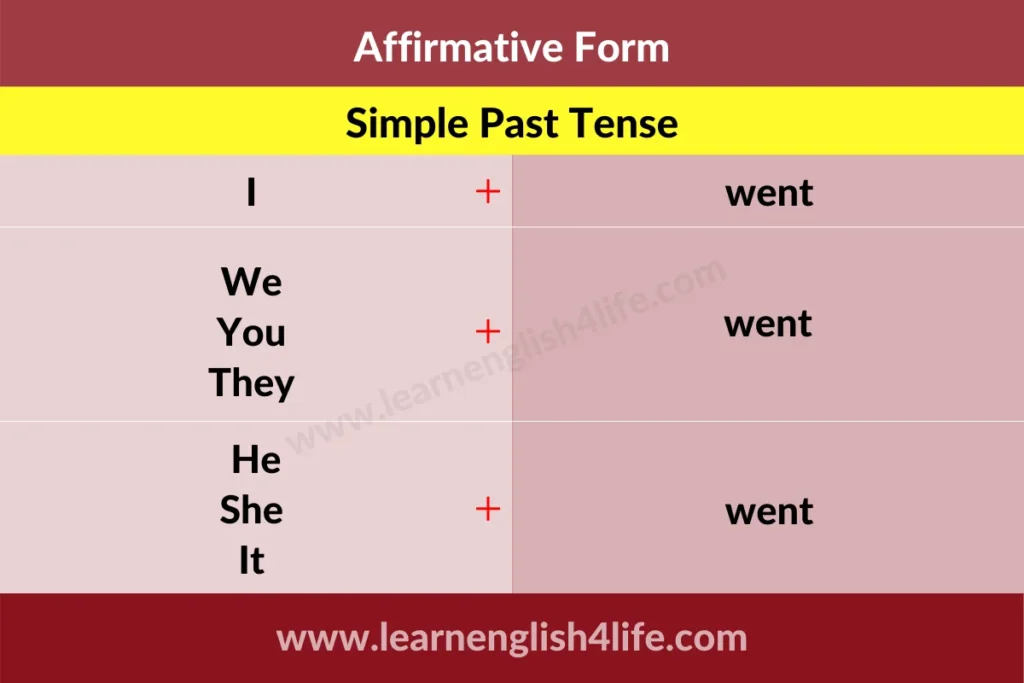
In the simple past we do not think about whether the subject is singular or plural. We only put the verb in its past form, and it stays the same for I, you, he, she, it, we and they.
Examples
- We ate pizza.
- She ate pizza.
Note
Went is the past tense of the verb go. As the table shows, it does not change with the subject of the sentence: I went, she went, they went.
Examples
- I ate an apple.
- She ate an apple.
- They played.
- She played.
- We studied.
- Anne studied.
Regular and irregular verbs
Regular verbs make the past with -ed. Irregular verbs have special past forms that you need to learn, such as eat, ate, go, went, see, saw and teach, taught. Our lesson on regular and irregular verbs has a full list.
| Verb ending | Rule | Example |
|---|---|---|
| Most verbs | add -ed | play → played, visit → visited |
| Ending in -e | add -d | close → closed, live → lived |
| Consonant + y | change y to -ied | study → studied, cry → cried |
| Short verb: consonant + vowel + consonant | double the last letter | stop → stopped, plan → planned |
Note
The verb ‘be’ has two past forms: was (I, he, she, it) and were (you, we, they). He was in the garden. They were busy. See the verb ‘be’ lesson for the present forms.
How do you make the negative?
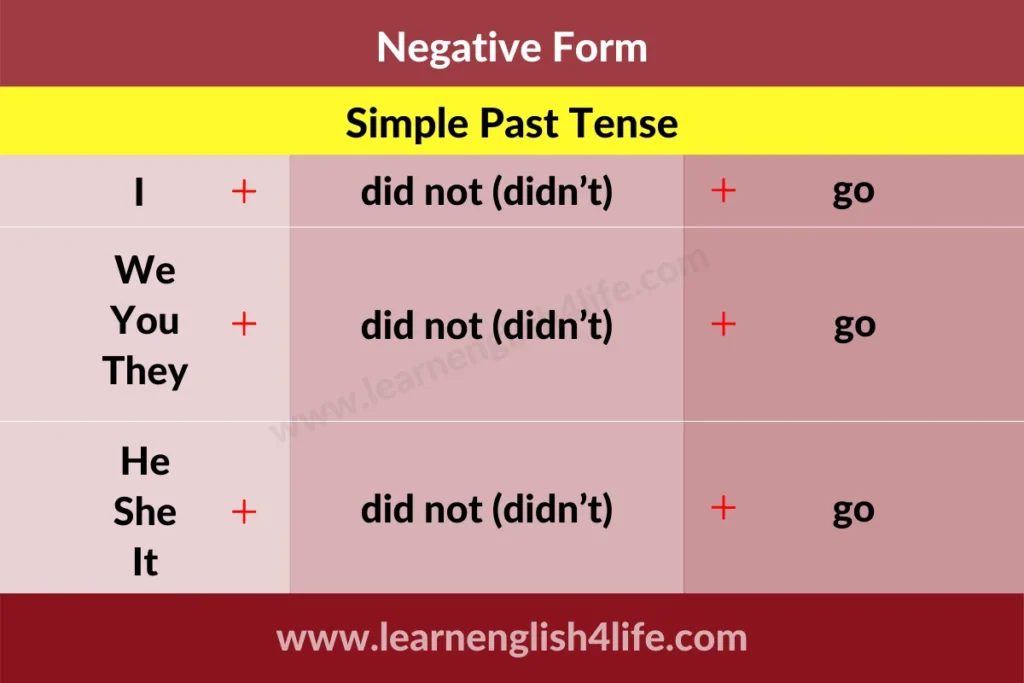
We use did not (didn’t) to make negative sentences in the past tense. After didn’t, the main verb goes back to its base form.
Examples
- I did not live in Australia. / I didn’t live in Australia.
- You did not play. / You didn’t play.
- She did not close the door. / She didn’t close the door.
- He did not fight. / He didn’t fight.
- Sam did not read the book. / Sam didn’t read the book.
Common mistake
I didn’t saw the film. → I didn’t see the film.
How do you ask questions in the simple past?
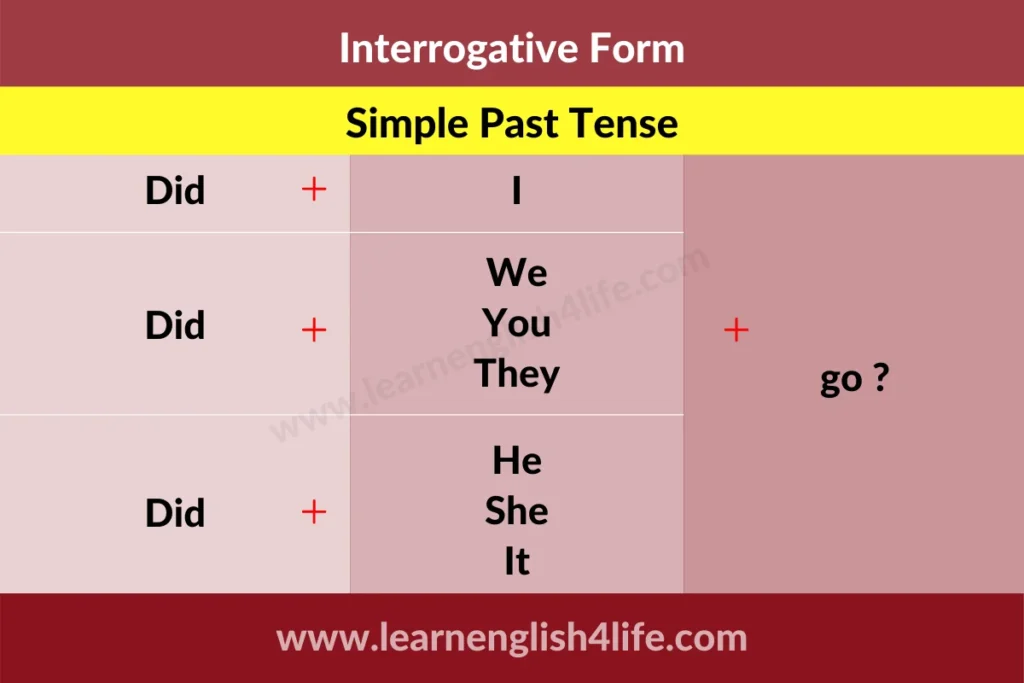
In the simple past tense, we use the helping verb did at the beginning of the sentence to make questions: Did + subject + base verb?
Examples
- Did I play?
- Did you study?
- Did we read?
- Did she cry?
- Did he start?
Short answers and question words
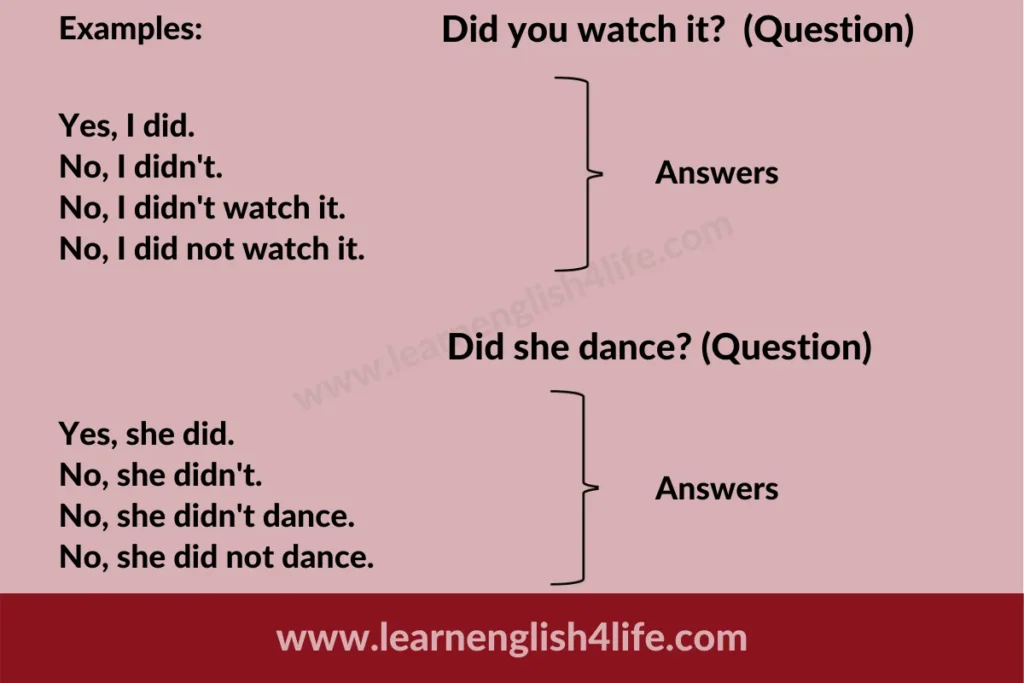
Answer with Yes, I did or No, I didn’t. With a question word, put it before did: Where did you go? What did she say?
Common mistake
Did she went to school? → Did she go to school?
Tip
Only one word shows the past. If you use did, the main verb stays in the base form: did go, didn’t eat. Without did, the main verb takes the past form: went, ate.
Simple past or another past tense?
Use the past continuous tense for an action that was in progress at a past time (I was reading when she called). Use the present perfect tense when the time is not finished or not important (I have seen that film). For habits and facts in the present, go back to the simple present tense. For more practice, read the British Council grammar reference on the past simple.
Summary
- Use the simple past for finished actions in the past.
- Regular verbs add -ed; irregular verbs have special forms (go, went).
- The past verb is the same for every subject.
- Negative: didn’t + base verb (She didn’t close the door).
- Question: Did + subject + base verb (Did you study?).
Frequently asked questions
Does the simple past change with he, she or it?
No. The past form is the same for all subjects: I played, she played, they played. The only exception is the verb be, which has was and were.
How do I know if a verb is regular or irregular?
Regular verbs end in -ed in the past, such as played and studied. Irregular verbs, such as went, ate and saw, must be learnt from a list.
Why do we say “Did you go” and not “Did you went”?
Did already shows the past, so the main verb goes back to its base form. Use only one past form in a question or a negative.
Which time words go with the simple past?
Common ones are yesterday, last night, last week, two days ago and in 2010. They show that the action happened at a finished time.
What is the difference between the simple past and the present perfect?
The simple past is for a finished time: I saw Kathy last February. The present perfect connects the past to now: I have seen Kathy.
Practise this lesson
5 questions
5 questions
5 questions
5 questions