Animal names in English (types of animals)
Learn nearly 90 animal names in English, grouped by type, with simple meanings, example sentences and picture charts for each group.
In this lesson
Animal names in English are the words we use for pets, farm animals, wild animals, sea creatures, birds and insects. This lesson groups nearly 90 animal names by type, with a simple meaning and an example sentence for each one, plus picture charts to help you remember them.
Key point
Learn animal names in groups, such as pets or sea animals. Some animals belong to more than one group: a horse can be a pet, a domestic animal and a farm animal.
What are the main types of animals?
We can sort animals into these basic groups:
- Pets: animals that live with people at home.
- Domestic animals: animals that people keep and look after.
- Farm animals: animals kept on farms for food, milk, wool or work.
- Wild animals: animals that live in nature.
- Mammals: animals that feed their babies with milk.
- Sea animals: animals that live in or near the sea.
- Birds: animals with feathers, wings and a beak.
- Insects: small animals with six legs.
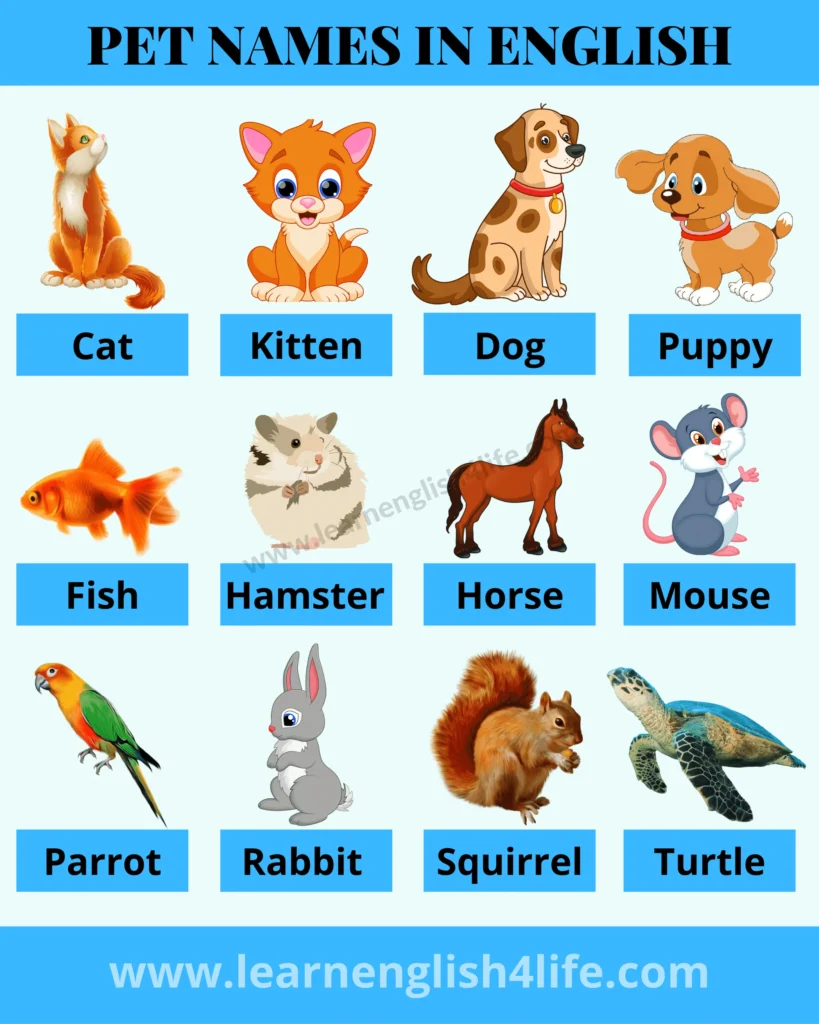
Pet names in English
| Word | Meaning | Example |
|---|---|---|
| cat | A small furry animal that people often keep as a pet. | Our cat sleeps on the sofa all afternoon. |
| kitten | A young cat. | The kitten is playing with a ball of wool. |
| dog | An animal that people keep as a pet or to guard their homes. | My dog barks when someone comes to the gate. |
| puppy | A young dog. | We got a puppy for my birthday. |
| fish | An animal that lives in water and breathes through gills. | Our pet fish swim around a glass tank. |
| hamster | A small furry animal like a mouse, often kept in a cage. | The hamster runs on its wheel at night. |
| horse | A large animal that people ride or use for work. | She rides her horse every weekend. |
| mouse | A very small animal with a long tail; the plural is mice. | The pet mouse lives in a small cage. |
| parrot | A brightly coloured bird that can copy human speech. | Our parrot can say “hello”. |
| rabbit | A small animal with long ears and a short, fluffy tail. | The rabbit is eating a carrot. |
| squirrel | A small animal with a long, bushy tail that lives in trees. | A squirrel is running along the wall. |
| turtle | An animal with a hard shell that lives mainly in water. | The turtle swims slowly in its tank. |
Domestic animals
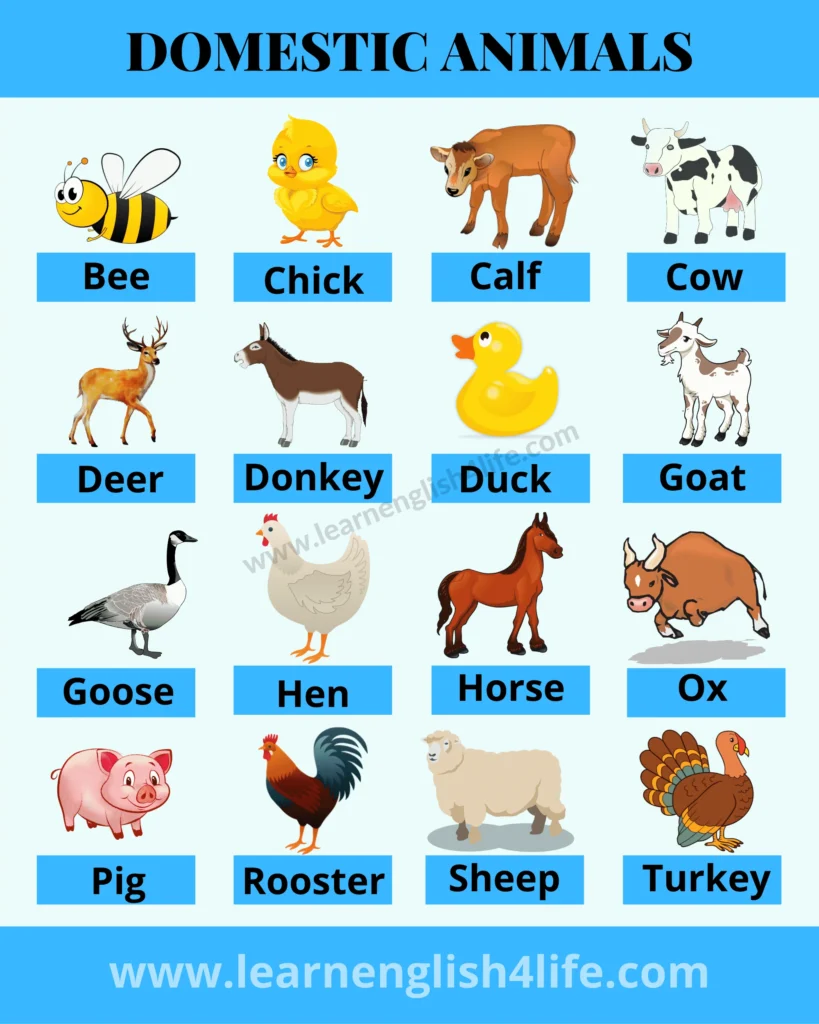
Domestic animals live with people, who feed them and look after them. Bees and deer are not fully domestic, but people keep bees for honey and farm deer in some countries.
| Word | Meaning | Example |
|---|---|---|
| bee | A flying insect that makes honey. | Bees make honey from flowers. |
| calf | A young cow; the plural is calves. | The calf is drinking milk from its mother. |
| chick | A baby bird, especially a young chicken. | The chicks follow the hen everywhere. |
| cow | A large farm animal that gives milk. | The cow gives us fresh milk every day. |
| deer | A fast animal with long legs; the males have antlers. | We saw a deer near the forest. |
| donkey | An animal like a small horse with long ears. | The donkey carries heavy bags up the hill. |
| duck | A water bird with short legs and a wide, flat beak. | The ducks are swimming in the pond. |
| goat | An animal with horns, kept for its milk and meat. | The goat is eating grass by the road. |
| goose | A large water bird, bigger than a duck; the plural is geese. | A goose is chasing the children. |
| hen | A female chicken. | Our hen lays an egg every day. |
| horse | A large animal that people ride or use for work. | The farmer uses a horse to pull the cart. |
| ox | A large male cow used for pulling carts and ploughs; the plural is oxen. | Two oxen are pulling the cart. |
| pig | A farm animal with a flat nose and a curly tail. | The pig is rolling in the mud. |
| rooster | A male chicken. | The rooster crows early in the morning. |
| sheep | A farm animal kept for its wool and meat. | The sheep have thick, white wool. |
| turkey | A large bird kept for its meat. | Some families eat turkey at Christmas. |
Farm animals
| Word | Meaning | Example |
|---|---|---|
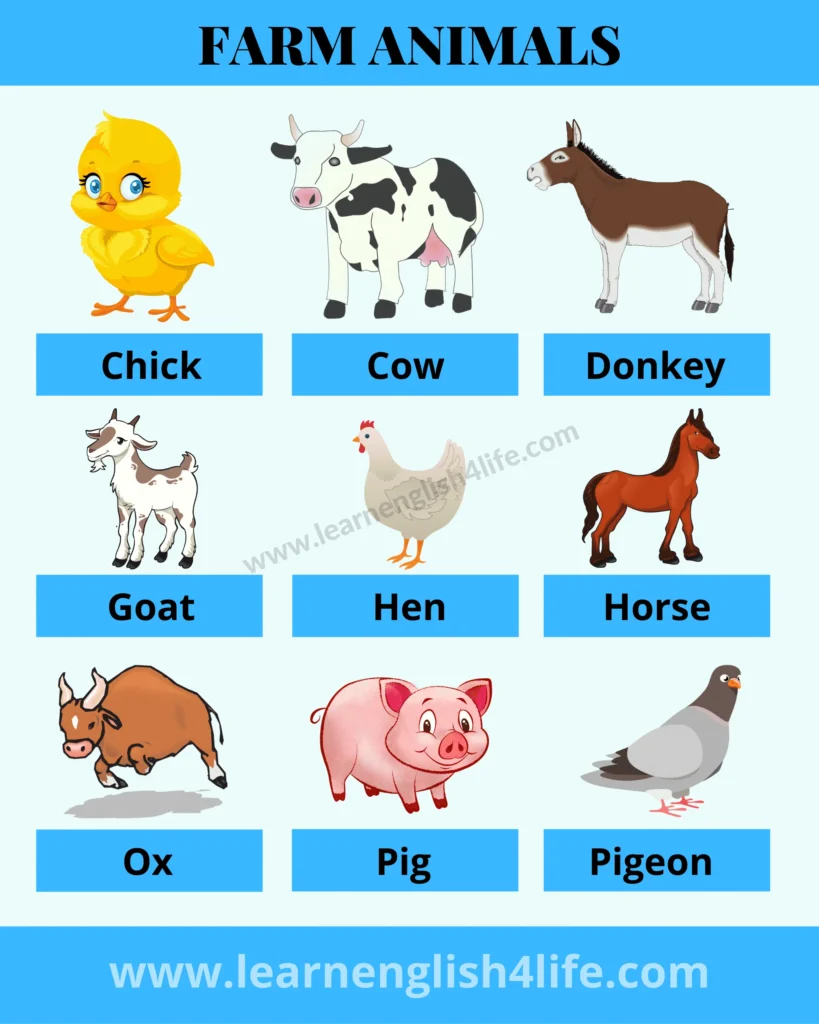
| chick | A baby bird, especially a young chicken. | The farmer keeps the chicks warm under a lamp. |
| cow | A large farm animal that gives milk. | The farmer milks the cows every morning. |
| donkey | An animal like a small horse with long ears. | The donkey works hard on the farm. |
| goat | An animal with horns, kept for its milk and meat. | Goats can climb steep, rocky hills. |
| hen | A female chicken. | The hens are eating corn in the yard. |
| horse | A large animal that people ride or use for work. | Horses need plenty of water and grass. |
| ox | A large male cow used for pulling carts and ploughs; the plural is oxen. | The ox pulls the plough through the field. |
| pig | A farm animal with a flat nose and a curly tail. | Pigs eat almost anything. |
| pigeon | A grey bird often seen in towns and on farms. | Pigeons are eating seeds in the yard. |
| rooster | A male chicken. | The rooster wakes everyone up at dawn. |
| sheep | A farm animal kept for its wool and meat. | The farmer has fifty sheep. |
| turkey | A large bird kept for its meat. | The turkeys are walking around the farmyard. |
Common mistake
The farmer has three sheeps and two oxes. → The farmer has three sheep and two oxen.
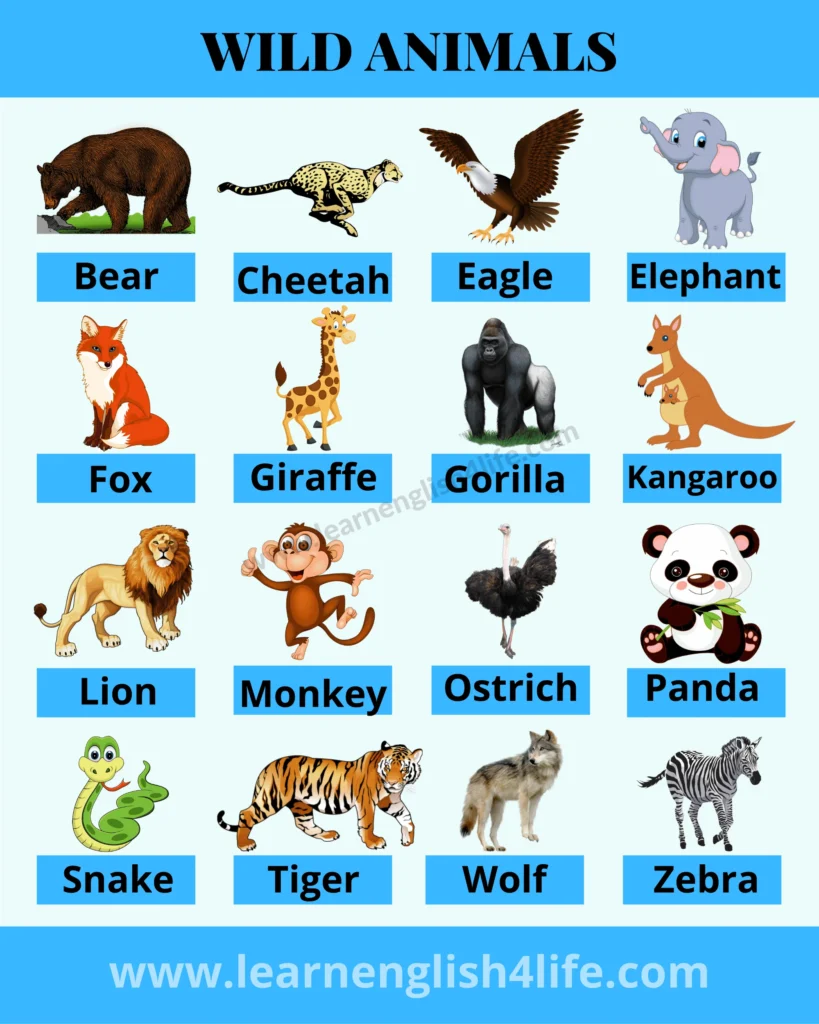
Wild animals
| Word | Meaning | Example |
|---|---|---|
| bear | A large, heavy animal with thick fur. | The bear is catching fish in the river. |
| cheetah | A wild cat with spots; it is the fastest land animal. | A cheetah can run very fast. |
| eagle | A large bird that hunts small animals. | The eagle flew high above the mountains. |
| elephant | A very large grey animal with a long trunk. | Sri Lanka is home to many wild elephants. |
| fox | A wild animal like a dog, with red fur and a bushy tail. | The fox hunts at night. |
| giraffe | A tall African animal with a very long neck. | The giraffe eats leaves from tall trees. |
| gorilla | A very large, strong ape from Africa. | The gorilla is resting in the forest. |
| kangaroo | An Australian animal that jumps and carries its baby in a pouch. | The baby kangaroo is in its mother’s pouch. |
| lion | A large wild cat; the male has a mane. | The lion is resting in the shade. |
| monkey | An animal with a long tail that lives in trees. | The monkeys took the bananas from our table. |
| ostrich | A very large bird that cannot fly but runs fast. | An ostrich cannot fly, but it runs very fast. |
| panda | A black and white bear from China that eats bamboo. | The panda is eating bamboo. |
| snake | A long animal with no legs. | Be careful, there is a snake in the grass. |
| tiger | A large wild cat with orange fur and black stripes. | The tiger is hiding in the long grass. |
| wolf | A wild animal like a large dog; the plural is wolves. | Wolves hunt in groups called packs. |
| zebra | An African animal like a horse, with black and white stripes. | A zebra is drinking at the river. |
For more names, browse the Cambridge Dictionary word list for wild mammals.
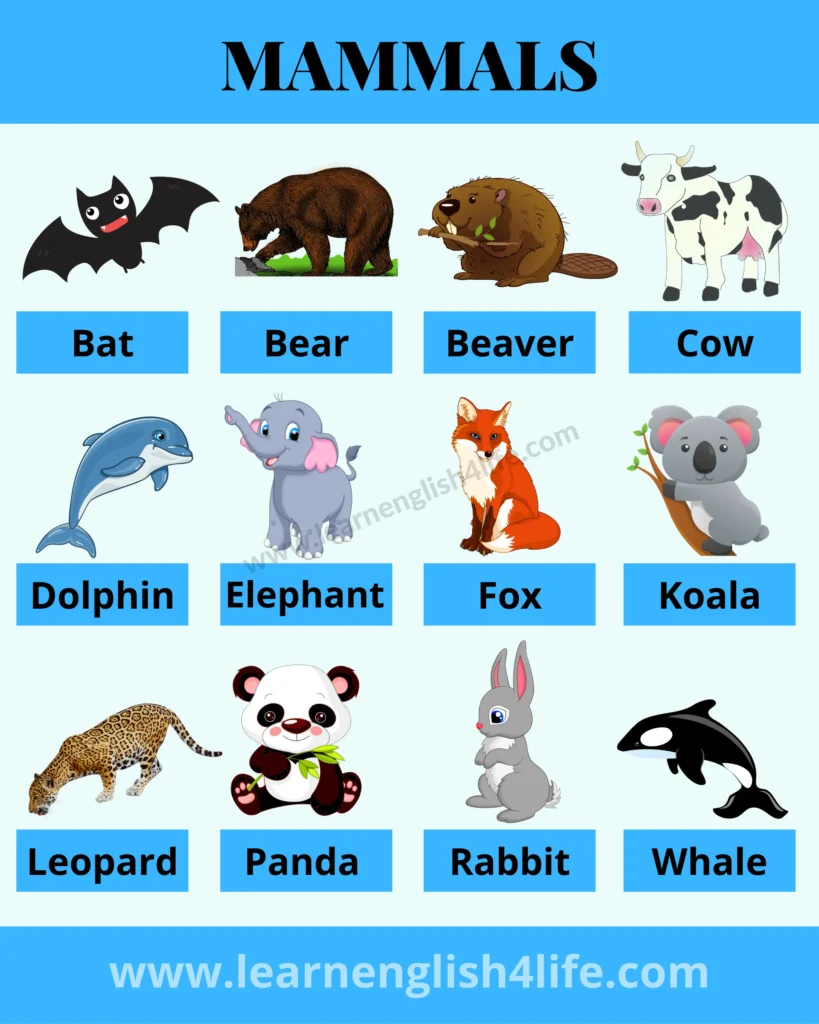
Mammals
Mammals are animals that feed their babies with milk. Most mammals live on land, but bats can fly, and dolphins and whales live in the sea.
| Word | Meaning | Example |
|---|---|---|
| bat | A small flying mammal that is active at night. | Bats sleep upside down during the day. |
| bear | A large, heavy animal with thick fur. | Some bears sleep through the winter. |
| beaver | An animal with a flat tail that builds dams in rivers. | The beaver is building a dam. |
| cow | A large farm animal that gives milk. | A cow feeds its calf with milk. |
| dolphin | An intelligent, playful sea mammal. | We watched dolphins jumping out of the sea. |
| elephant | A very large grey animal with a long trunk. | An elephant uses its trunk to drink water. |
| fox | A wild animal like a dog, with red fur and a bushy tail. | Foxes live in holes in the ground. |
| koala | An Australian animal that lives in trees and eats eucalyptus leaves. | The koala is sleeping in a tree. |
| leopard | A large wild cat with yellow fur and black spots. | We saw a leopard at Yala National Park. |
| panda | A black and white bear from China that eats bamboo. | Pandas spend many hours a day eating. |
| rabbit | A small animal with long ears and a short, fluffy tail. | Rabbits live in holes called burrows. |
| whale | A very large sea mammal. | The blue whale is the largest animal on Earth. |
Sea animals
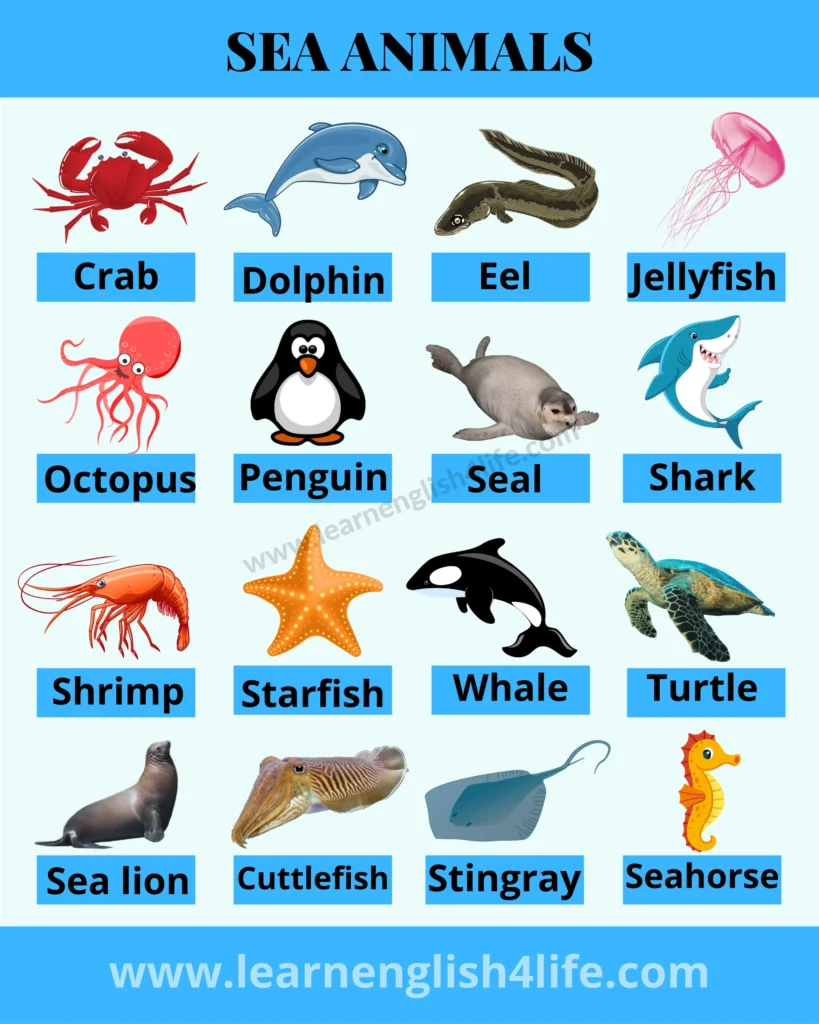
A penguin is a bird and a seal is a mammal, but both spend a lot of their lives in the sea.
| Word | Meaning | Example |
|---|---|---|
| crab | A sea animal with a hard shell and ten legs that walks sideways. | The crab walked sideways across the sand. |
| dolphin | An intelligent, playful sea mammal. | Dolphins often swim in groups. |
| eel | A long fish that looks like a snake. | The eel hid between the rocks. |
| jellyfish | A soft sea animal with long, stinging tentacles. | Don’t touch the jellyfish; it can sting you. |
| octopus | A sea animal with eight long arms. | The octopus changed colour to hide. |
| penguin | A black and white seabird that swims but cannot fly. | Penguins live mostly in the southern half of the world. |
| seal | A sea mammal with flippers that lives in the sea and on land. | A seal is lying on the rocks. |
| shark | A large fish with sharp teeth. | The shark swam close to the boat. |
| shrimp | A small sea animal with a shell, often eaten as food. | We had shrimp curry for lunch. |
| starfish | A flat sea animal shaped like a star. | We found a starfish on the beach. |
| walrus | A large sea mammal with two long tusks. | The walrus is resting on the ice. |
| whale | A very large sea mammal. | Whales come up to the surface to breathe. |
| turtle | An animal with a hard shell that lives mainly in water. | Sea turtles lay their eggs on the beach. |
| sea lion | A large seal with small ear flaps that can walk on land. | The sea lion is playing with a ball. |
| cuttlefish | A sea animal like a small squid, with a wide, flat body. | The cuttlefish can change its colour. |
| stingray | A flat fish with a long tail that can sting. | A stingray is lying on the sandy sea floor. |
| seahorse | A small fish whose head looks like a horse’s head. | The male seahorse carries the babies. |
Birds
| Word | Meaning | Example |
|---|---|---|
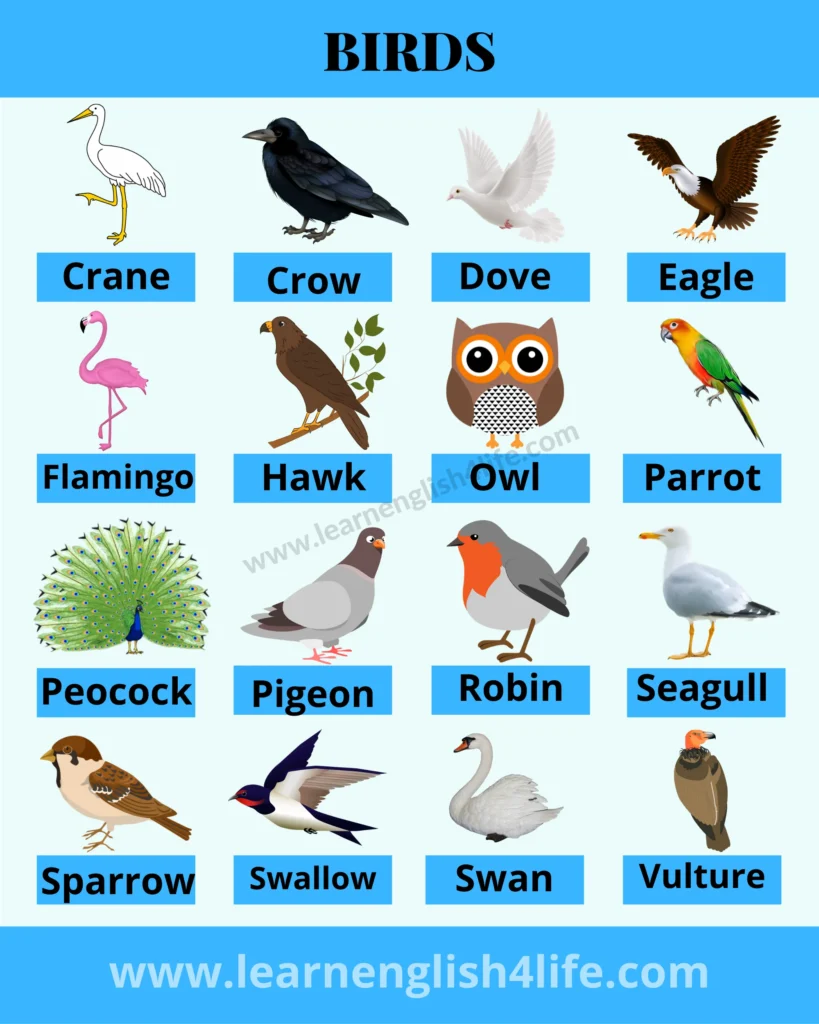
| crane | A tall bird with long legs and a long neck. | A crane is standing in the shallow water. |
| crow | A large black bird. | A crow is sitting on the roof. |
| dove | A white or grey bird, often a symbol of peace. | The dove is a symbol of peace. |
| eagle | A large bird that hunts small animals. | Eagles have very good eyesight. |
| flamingo | A pink bird with long legs and a long neck. | Flamingos often stand on one leg. |
| hawk | A bird with sharp claws that hunts small animals. | The hawk caught a mouse. |
| owl | A bird with big eyes that hunts at night. | We heard an owl in the night. |
| parrot | A brightly coloured bird that can copy human speech. | Parrots are often green, red or blue. |
| peacock | A male bird with long, colourful tail feathers. | The peacock spread its beautiful tail. |
| pigeon | A grey bird often seen in towns and on farms. | Pigeons live in many cities. |
| robin | A small bird with a red-orange breast. | A robin is singing in the garden. |
| seagull | A white and grey bird that lives near the sea. | Seagulls fly over the beach. |
| sparrow | A small brown bird. | A sparrow built a nest under our roof. |
| swallow | A small bird with a forked tail that flies fast. | Swallows fly long distances every year. |
| swan | A large white water bird with a long neck. | A swan is swimming on the lake. |
| vulture | A large bird that eats dead animals. | Vultures circled high in the sky. |
Insects and other small creatures
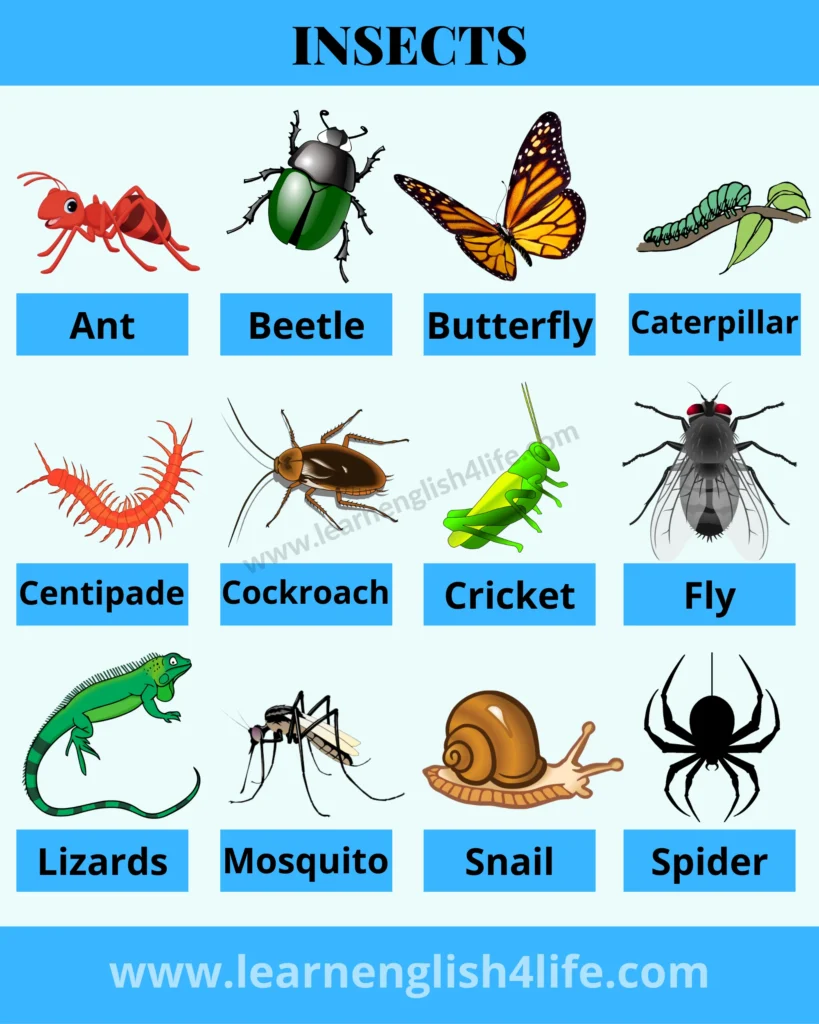
Insects have six legs. Spiders have eight legs, centipedes have many legs, snails have no legs and lizards are reptiles, so they are not insects. We include them here because they are small creatures you see every day.
| Word | Meaning | Example |
|---|---|---|
| ant | A very small insect that lives in large groups. | The ants are carrying food to their nest. |
| beetle | An insect with a hard, shiny back. | A black beetle is crawling on the leaf. |
| butterfly | An insect with large, colourful wings. | A butterfly landed on the flower. |
| caterpillar | The young form of a butterfly or moth; it looks like a worm. | The caterpillar is eating a leaf. |
| centipede | A small animal with a long body and many legs. | A centipede ran under the stone. |
| cockroach | A brown insect often found in kitchens. | I saw a cockroach in the kitchen. |
| cricket | A jumping insect that makes a loud sound at night. | Crickets chirp in the garden at night. |
| fly | A small flying insect with two wings. | A fly is buzzing around the room. |
| lizard | A small reptile with four legs and a long tail. | A lizard is climbing up the wall. |
| mosquito | A small flying insect that bites and can spread disease. | Mosquitoes can spread dengue. |
| snail | A small, soft animal with a shell on its back. | The snail moves very slowly. |
| spider | A small animal with eight legs that spins webs. | The spider is making a web. |
Note
Many animal names have irregular plurals: one sheep, two sheep; one deer, two deer; one mouse, two mice; one goose, two geese; one ox, two oxen; one wolf, two wolves. In British English, a tortoise is a turtle that lives only on land.
How can you learn animal names easily?
Tip
Use the picture charts. Cover the words, look at each picture and say the name aloud. Then make a short sentence about where the animal lives or what it eats, for example A cow lives on a farm and eats grass.
Next, learn the special words for the noises animals make, such as moo, quack and neigh, in our one-word substitution lesson, or listen to examples in the Cambridge Dictionary list of animal sounds. You can also study fruit names in English and vegetable names in English, review the grammar of singular and plural verbs, and look up any word in our English Word Bank.
Summary
- Animals can be grouped into pets, domestic animals, farm animals, wild animals, mammals, sea animals, birds and insects.
- Some animals, such as the horse and the cow, belong to more than one group.
- Baby animals often have their own names: kitten, puppy, calf and chick.
- Learn irregular plurals such as sheep, mice, geese and oxen.
- Spiders, snails and lizards are not insects.
Frequently asked questions
What is the difference between domestic and wild animals?
Domestic animals live with people or on farms, and people look after them. Wild animals live in nature, such as forests, mountains and the sea, and find their own food.
What are the names of baby animals in English?
In this lesson, a young cat is a kitten, a young dog is a puppy, a young cow is a calf and a young bird is a chick.
Is a spider an insect?
No. Insects have six legs, but spiders have eight. Scientists call spiders arachnids.
Is a whale a fish?
No, a whale is a mammal. It breathes air and feeds its babies with milk, like a dolphin.
What is the plural of sheep, mouse and goose?
The plural of sheep is sheep, the plural of mouse is mice and the plural of goose is geese.