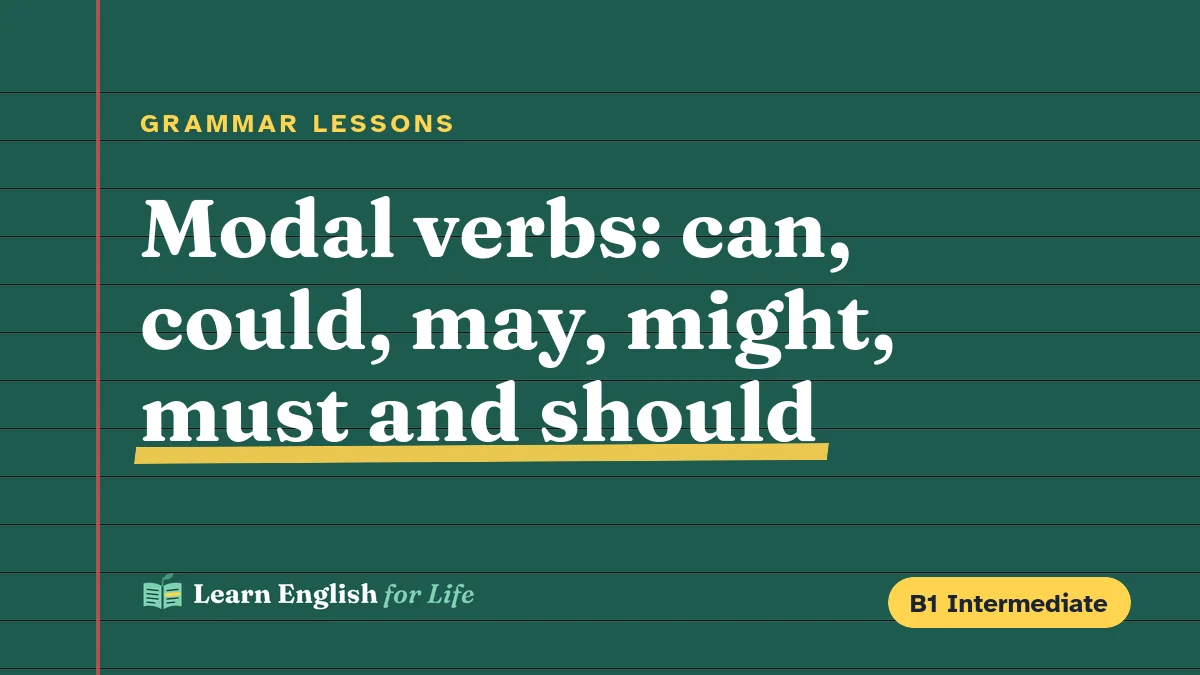
Modal verbs: can, could, may, might, must and should
Learn how to use can, could, may, might, must and should for ability, permission, possibility, obligation and advice, with examples and a quiz.
In this lesson
Modal verbs are helping verbs such as can, could, may, might, must and should. We put them before a main verb to show ability, permission, possibility, obligation or advice. A modal verb never changes its form, and the verb after it is always the base form: She can swim, not She can swims.
Key point
Use modal + base verb, with no to and no -s: He should study. Make negatives with not (can’t, mustn’t, shouldn’t) and questions by putting the modal first: Can you help me?
What are the rules for modal verbs?
Modal verbs work differently from ordinary verbs. Unlike verbs in the simple present tense, they never add -s, and they do not need do or does in questions and negatives. This table shows the basic forms.
| Form | Structure | Example |
|---|---|---|
| Positive | Subject + modal + base verb | Nimal can speak three languages. |
| Negative | Subject + modal + not + base verb | You mustn’t park here. |
| Question | Modal + subject + base verb? | Could you open the window? |
| Short answer | Yes / No + subject + modal | Yes, I can. No, she shouldn’t. |
- No -s: She must leave. (not She musts leave.)
- No to after the modal: I can drive. (not I can to drive.) The exceptions are ought to and have to.
- No do in questions: Can you swim? (not Do you can swim?)
- Only one form: modals have no -ing form and no past participle, so we use be able to and have to for other tenses.
Common mistake
He can to play the guitar. → He can play the guitar. Never put to between a modal verb and the main verb.
Note
In British English, cannot is written as one word. In speech we usually use short forms such as can’t, couldn’t, mustn’t and shouldn’t. Our lesson on contracted forms in English explains how they work.
How do you talk about ability with can and could?
Use can for ability in the present and could for general ability in the past. Modals have no future or perfect form, so use be able to for other tenses.
Examples
- Sanduni can play the piano very well.
- When he was five, Nimal could read in Sinhala and English.
- I will be able to drive after my test next month.
- We haven’t been able to find a flat in Colombo yet.
Note
For one specific success in the past, use was able to or managed to, not could: After two hours, we were able to find the hotel in Kandy.
How do you ask for and give permission?
We use can, could and may to ask for permission. They have the same meaning, but they are not equally polite.
| Modal | How it sounds | Example |
|---|---|---|
| can | Informal and friendly | Can I borrow your pen? |
| could | Polite | Could I leave early today? |
| may | Formal and very polite | May I come in? |
To give permission, say Yes, you can or Yes, of course. To refuse politely, say Sorry, you can’t or I’m afraid not.
Tip
Use could only to ask. When you give permission, answer Yes, you can, not Yes, you could.
How do you talk about possibility?
When we are not sure about the present or the future, we use may, might or could. All three mean perhaps. In everyday English they are very similar, although might can sound a little less certain.
Examples
- It might rain this afternoon, so take an umbrella.
- Nimal may be at the office. He often works late on Fridays.
- The train to Colombo could be late because of the floods.
- Sanduni might not come to the party. She has an exam on Monday.
Note
For a negative possibility, use may not or might not. Use must when you are almost sure something is true, and can’t when you are sure it is impossible: You’ve been working all day. You must be tired. That can’t be Sanduni. She is in Kandy this week.
How do you talk about obligation with must and have to?
Use must and have to when something is necessary. Their meanings are very close, with one small difference.
| Form | When we use it | Example |
|---|---|---|
| must | The speaker feels it is necessary | I must call my grandmother tonight. |
| have to | A rule or another person makes it necessary | We have to wear a uniform at school. |
| had to | Past obligation (must has no past form) | I had to work late yesterday. |
| will have to | Future obligation | You will have to show your passport at the airport. |
Remember that have to is an ordinary verb. It changes with he, she and it, and it uses do or does in questions and negatives: She has to leave at six. Does she have to leave so early?
What is the difference between mustn’t and don’t have to?
In the negative, the meaning changes completely. Mustn’t means it is not allowed, so do not do it. Don’t have to means it is not necessary, so you can choose.
Examples
- You mustn’t use your phone during the exam. (It is against the rules.)
- You don’t have to bring food. We will have lunch in Colombo. (It is not necessary.)
- Sanduni doesn’t have to work tomorrow because it’s a public holiday.
Common mistake
You mustn’t come to the meeting if you are busy. → You don’t have to come to the meeting if you are busy. The meeting is optional, so coming is not necessary: use don’t have to.
How do you give advice with should and ought to?
Use should to give advice or to say what is the right thing to do. Ought to has the same meaning, but it is less common and a little more formal. Shouldn’t means that something is not a good idea.
Examples
- You should see a doctor about that cough.
- You shouldn’t drink so much coffee at night.
- We ought to leave now, or we’ll miss the bus to Kandy.
- Should I call Nimal or send him a message?
How do you use could have, should have and might have?
To talk about the past, put have + past participle after the modal. You can review past participles in our lesson on regular and irregular verbs.
| Form | Meaning | Example |
|---|---|---|
| could have + past participle | It was possible, but it did not happen | You could have taken the train, but you drove. |
| should have + past participle | It was the right thing to do, but you did not do it | I should have studied harder for the test. |
| shouldn’t have + past participle | You did it, but it was a mistake | We shouldn’t have eaten so much rice and curry. |
| might have / may have + past participle | Perhaps it happened, but we are not sure | Nimal might have missed the bus. |
| must have + past participle | You are almost sure it happened | The roads are wet. It must have rained. |
Common mistake
I should of called you. → I should have called you. In speech, should have sounds like should’ve, but we never write of.
Modal verbs are also very common in conditional sentences (If it rains, we might stay at home) and in question tags (You can swim, can’t you?).
To go further, read the Cambridge Dictionary grammar guide to modal verbs and modality and the British Council LearnEnglish lesson on modals for permission and obligation.
Summary
- Modal verbs go before a base verb, with no to, no -s and no do: She can swim.
- Can and could show ability; can, could and may ask for permission.
- May, might and could show possibility; must and have to show obligation.
- Mustn’t means it is not allowed; don’t have to means it is not necessary.
- Should and ought to give advice; should have + past participle shows regret about the past.
Frequently asked questions
What is the difference between can and could?
Can is for present ability and informal requests: I can cook. Could is for past ability and for more polite requests: Could you help me, please?
Is must stronger than should?
Yes. Must shows a strong obligation or a rule, while should is only advice. You must stop at a red light, but you should drive slowly in the rain.
Can I say “I must to go”?
No. Modal verbs are followed by the base verb without to: I must go. The only exceptions are ought to and have to, which always include to.
What is the past tense of must?
Must has no past form. For a past obligation, use had to: I had to wear a uniform at school. For a past deduction, use must have: He must have forgotten.
Practise this lesson
10 questions